Material Verification at the Factory Gate: What Guards Should Check
Published on 10/31/2026
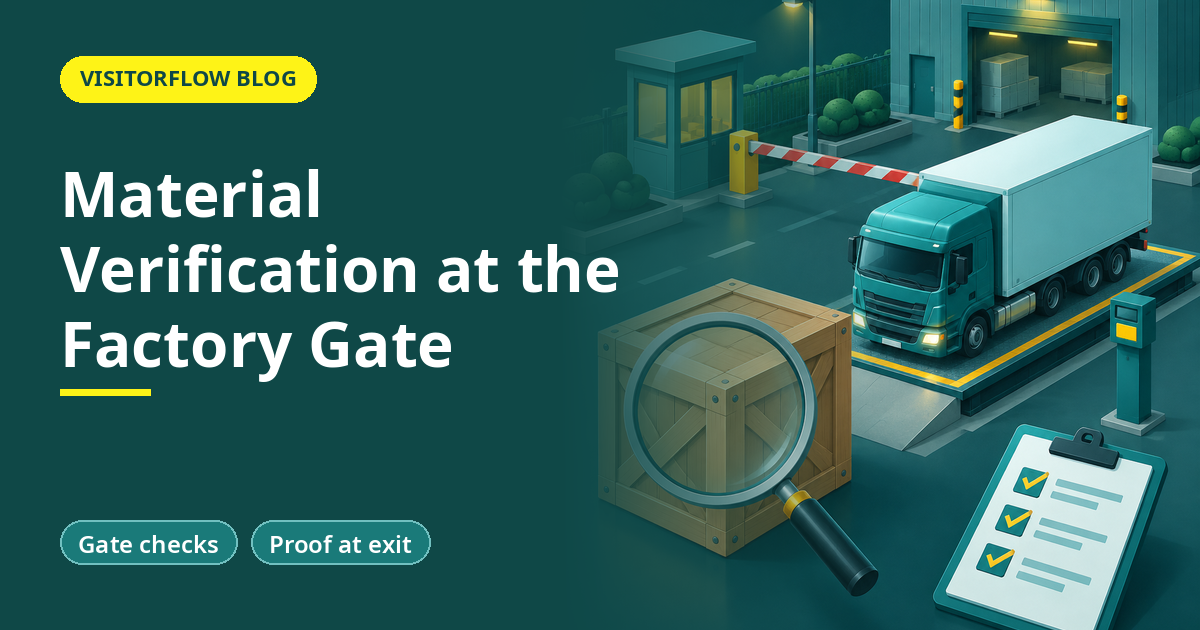
A tempo pulls up at the outbound gate of an auto parts plant with a gate pass for 40 cartons. The guard glances at the paper pass, glances at the stacked cartons, waves the vehicle through. Three weeks later, stores reports a shortage of 6 cartons of machined parts, and nobody can say whether they left through that gate or never existed. The pass said 40. Nobody counted 40.
Material verification is the moment where a gate pass stops being paperwork and becomes control. This guide lays out a verification routine a guard can actually run in two minutes per vehicle: what to match, what to do when the material does not match the pass, and how to keep the record so a later audit reconstructs exactly what left.
On this page
What verification at the gate actually means
Verification is three matches, done every time: the material matches the pass, the pass is genuine and current, and the vehicle and driver match who was expected. If any of the three fails, the vehicle does not move until the mismatch is resolved. That is the whole principle; everything else is technique for doing it fast.
The failure mode at most gates is not dishonesty, it is drift. Guards verify properly for the first month, then volume and familiarity erode the habit until the check is a wave-through. The routine below is designed to survive drift: it is short, identical every time, and produces a record that a supervisor can review.
Key idea: A gate pass controls nothing by itself. The control is the two minutes a guard spends proving the pass describes the actual material in the actual vehicle.
The two-minute verification routine
Five steps, in order, for every vehicle carrying material. With a digital pass the first two steps take seconds, because the pass opens on the guard's phone with one scan.
Step 01
Open the pass, confirm it is genuine and open
Scan the QR on the pass or pull it up by number. Confirm the pass exists in the system, is approved, and has not already been used. A pass that scans to "already exited" or "not found" stops the vehicle immediately.
Step 02
Check the vehicle and driver
Match the vehicle number on the pass to the number plate. If the pass names a transporter or driver, match that too. Material leaving in a different vehicle than approved is a classic leakage pattern.
Step 03
Count or measure against the pass
Count cartons, pieces or bundles against the pass quantity. For bulk material, check the weighbridge slip against the pass. For high-value small items, open a sample of packages rather than trusting labels.
Step 04
Check for what is not on the pass
Walk around the vehicle once. Look for material that is not listed: extra cartons on top, items in the driver's cabin, toolboxes leaving "for repair" with no pass. The walk-around catches what counting cannot.
Step 05
Close the pass with evidence
Mark the pass exited in the system with a photo of the loaded vehicle and the number plate. The photo takes five seconds and settles every later dispute about what condition the material left in.
Handling mismatches without drama
Most mismatches are clerical: the pass says 40 boxes, stores loaded 42, the paperwork lagged the loading bay. The guard's job is not to accuse, it is to hold the vehicle and get the pass corrected. Three rules keep this calm:
- The vehicle waits in a marked holding lane, not at the barrier, so the queue behind keeps moving.
- The guard calls the pass issuer, not the driver's contact. The issuer corrects the pass or sends someone to explain the difference.
- Every mismatch gets logged with a photo, even when resolved in five minutes. The log is how you spot a pattern of "clerical errors" from one department.
Give your guards a pass they can verify in seconds
VisitorFlow gate passes carry a QR that opens the live pass on the guard's phone, with quantity, vehicle, photo capture and exit stamping built in.
Explore Material Gate Pass SoftwareInward vs outward verification
The same three matches apply in both directions, with a different reference document. Outward material is verified against your gate pass. Inward material is verified against the supplier's delivery challan and your purchase order, and the gate entry becomes the trigger for goods receipt.
| Check | Inward material | Outward material |
|---|---|---|
| Reference document | Supplier delivery challan + your PO | Your gate pass, scanned at the gate |
| Quantity check | Count against challan; shortages noted on the receipt | Count against pass; excess holds the vehicle |
| Mismatch owner | Purchase or stores team accepts or rejects | Pass issuer corrects or cancels |
| Record created | Inward entry with challan photo, triggers goods receipt | Exit stamp on the pass with vehicle photo |
What verification is worth in rupees
Gate checks feel like overhead until you price one undetected leak. The worked example below uses conservative figures for a mid-size engineering plant; replace them with your own shrinkage history.
One carton a week of a mid-value part justifies the routine on its own. Plants that start measuring mismatch logs usually find the leak was larger than anyone estimated, because small shortages never looked worth reporting on their own.
Keeping every guard consistent
Verification quality varies between guards and between shifts unless you manage it. Three practices hold the standard:
Practices that hold the standard
- ✓ Post the five-step routine at the gate in the guard's language, one laminated page.
- ✓ Supervisors re-verify one in every twenty exits at random and record the result.
- ✓ Review the mismatch log monthly by issuing department, not by guard.
- ✓ Rotate guards across gates so familiarity with regular transporters does not soften the check.
Mistakes that defeat verification
- ✗ Verifying only outbound and waving inbound through, which leaves purchase shortages undiscoverable.
- ✗ Letting supervisors phone in verbal approvals to skip the check for "urgent" dispatches.
- ✗ Accepting a photo of a pass on the driver's phone as the pass, with no way to confirm it is genuine and unused.
Five-minute self-check for your gate
Answer yes or no for your busiest outbound gate.
- Can you pull up any single dispatch from last month, with photo, in under five minutes?
- Does every pass show who approved it and who verified it at the gate?
- Would a reused or photocopied pass be caught at the barrier today?
- Is there a written rule for what happens to a vehicle during a mismatch?
- Does anyone review mismatches by department every month?
Two or more "no" answers mean material is leaving on trust, not on verification.
Reader Q&A
Does counting every vehicle slow the gate down?
The five-step routine takes about two minutes for a routine load, which is faster than the paperwork it replaces. Full counts are for countable items; bulk and liquid loads verify against weighbridge and dip-rod readings instead.
What if a driver refuses to wait during a mismatch?
The vehicle stays. That rule must come from management in writing, otherwise the guard absorbs the pressure alone. A marked holding lane and a call to the pass issuer resolve most cases in minutes.
Should guards open sealed packages?
For high-value or high-shrinkage items, yes, on a sample basis, with the opening and resealing noted on the pass. For standard cartons, a label and count check plus random supervisor re-verification is usually enough.
How do we verify material leaving with contractors and visitors?
The same way: any material crossing the gate needs a pass, whether it travels in a truck or a laptop bag. Tool passes and laptop passes exist precisely so personal items are declared once and matched on exit.
What records should verification produce for an audit?
The closed pass with exit timestamp, the guard's identity, the vehicle photo and any mismatch note. With those four, an auditor can reconstruct any dispatch months later without interviewing anyone.
Who should issue passes: stores, security or the department sending material?
The department sending the material requests the pass, an approver outside that department authorises it, and security only verifies. Splitting request, approval and verification is what makes the pass a control rather than a receipt.
Can verification work at unmanned or night gates?
Only with tight rules: pre-approved passes, camera coverage and a next-morning review of every night movement. Most plants simply block material movement outside supervised hours, which is the safer default.
Bottom line
This week, print the five-step routine for your main gate and watch ten exits against it. Count how many would have caught a mismatch, and you have the size of your current exposure.
This quarter, move passes to a QR-based system so verification starts with a scan, and begin the monthly mismatch review by department. The metric to watch is the share of exits closed with a photo and a counted quantity: when it holds above 98 percent, the gate is a control, not a formality.
Related reading
Material Gate Pass Software (product) · Gate Pass pillar: all guides · Digital Gate Pass System · Finished Goods Gate Pass
Make every exit verifiable in two minutes
VisitorFlow runs visitor, material gate pass, courier, maintenance and incident workflows on one cloud platform, with no hardware at the gate.
Explore Material Gate Pass Software See Visitor Management Software Book a Free Demo
Aadeshwar Modi is a marketing technical content writer who loves writing on technology and AI topics.
- The OSHA 300 Log, Explained: What to Record and When
- Registered Post Handling in the Office: A Defensible Routine
- Forklift Daily Inspection Checklist: The Pre-Start Routine
- Transformer Maintenance Checklist: From Daily Walk-Past to Oil Tests
- The Boiler Maintenance Checklist: Daily, Weekly, Annual
- Maintenance SLAs: Response Time vs Resolution Time
- Connecting Gate Passes to Tally and SAP: An Integration Guide
- Gate Pass Audit: Reconciling Passes with Stock Records
- QR Code Gate Passes: How They Work at the Factory Gate
- 25 Questions to Ask a Visitor Management Vendor Before You Buy