Finished Goods Gate Pass: Make Invoice, Truck and Gate Agree
Published on 10/21/2026 • Updated on 10/22/2026
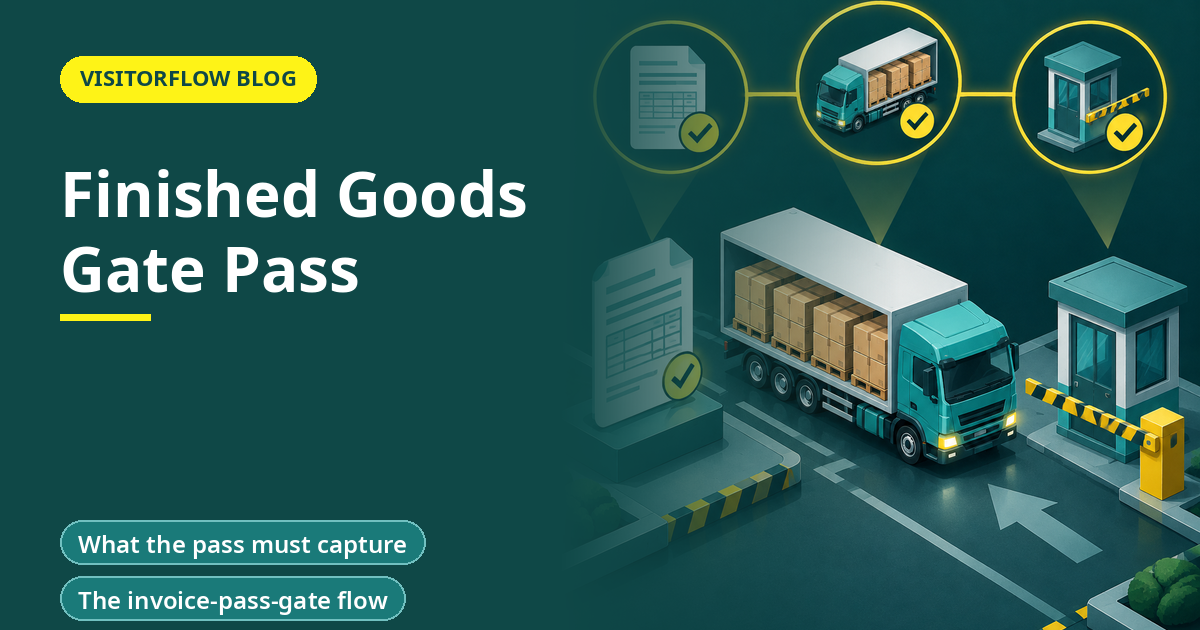
A consumer goods factory in Baddi dispatches 40 trucks a day from its finished goods store. On a busy Friday, a truck loaded for distributor A leaves on a pass written for distributor B's order, because both trucks were at the dock and the supervisor transposed the slips. The error surfaces on Monday when distributor A reports a short receipt and distributor B reports excess stock they cannot bill. The freight both ways, the credit notes and the weekend of reconciliation cost more than the margin on both orders.
Finished goods dispatch is the highest-value material movement in the factory, and the one where the gate, the invoice and the truck must agree to the last carton. This guide walks through setting up a finished goods gate pass process that holds under dispatch pressure: what the pass must capture, how it ties to the invoice, how the gate verifies the load, and how digital passes close the gap. For the broader framework, our guide to the digital gate pass system covers all pass types; this article is about the dispatch flow specifically.
On this page
Why dispatch passes fail under pressure
Dispatch is where factory processes meet a deadline that honks. Four pressures break paper passes. Volume: dozens of trucks in the evening window, each waiting on a document. Multiplicity: the invoice, the e-way bill, the packing list and the gate pass are four documents for one truck, and paper lets them disagree. Substitution: the load that was picked is not always the load that was packed, and the pass describes the first. And transposition: two trucks at the dock, two slips in hand, one swapped stack.
The expensive failures are rarely dramatic theft; they are mismatches. The invoice says 400 cartons, the truck carries 380, the customer receives 380 and disputes the invoice, and the factory cannot prove which document was right. The pass that is generated from the invoice, verified against the physical load, and photographed at exit is the one that ends those disputes with evidence instead of goodwill.
Key idea: In dispatch, the pass is not permission to leave; it is the contract between the invoice and the truck bed, and it earns its keep on the day they disagree.
There is a fifth pressure that rarely gets named: the evening crowd at the gate office itself. When passes are handwritten, the gate office becomes a queue of drivers waiting for a clerk who is transcribing from an invoice they cannot quite read. Errors are born in that queue: digits transposed, destinations abbreviated, vehicle numbers guessed from memory. Any redesign that does not remove the queue will be bypassed by the end of the first month, because dispatch pressure always wins against paperwork.
The financial stakes justify the rigour. Finished goods carry the full value of your raw material, conversion cost and margin; a single misdirected truck is often a six-figure error, and a slow three-cartons-per-truck drift compounds into a stock reconciliation that consumes a quarter's credibility with the auditors.
What the pass must capture
A finished goods gate pass that survives a customer dispute carries these fields, all mandatory:
- Invoice number and e-way bill number, so the pass is anchored to the tax document, not floating beside it.
- Customer or consignee name and destination, matching the invoice exactly.
- Line items with SKU, quantity and unit, generated from the invoice rather than retyped.
- Transporter name, vehicle number and driver details, captured at the gate.
- Gross and tare weights from the weighbridge for weight-sensible goods.
- A photo of the loaded, sealed vehicle before exit, and the seal number.
- The approving authority, separate from the person who prepared the pass.
The generation rule matters more than any field: the pass must be created from the invoice (or the delivery order that created the invoice), never typed afresh. A retyped pass is a second source of truth, and two sources of truth is a dispute waiting for a truck.
The invoice-pass-gate flow
The flow that keeps the three documents agreeing has five steps:
Step 01
The invoice generates the pass
Once the invoice is cut, the pass inherits its customer, destination and line items. The dispatch team cannot edit the quantities; a change means a corrected invoice, which is exactly as annoying as it should be.
Step 02
Packing confirms the physical load
The packing supervisor confirms the picked quantity against the pass line by line, and flags any substitution (a different SKU, a short-shipped line) before the truck is loaded, not after the customer calls.
Step 03
The approving authority releases the dispatch
The dispatch head approves on their phone: customer, value, credit status, vehicle. The maker-checker split keeps the person who loaded the truck from being the person who released it.
Step 04
The gate matches vehicle, seal and photo
Security verifies the vehicle number against the pass, records the seal number, photographs the sealed truck, and marks the pass exited. The transposition error from the opening story dies here: the pass and the truck cannot be swapped when the gate matches them digitally.
Step 05
Receipt disputes get answered from the record
When the customer reports a shortage, the pass answers with the invoice lines, the packing confirmation, the weights, the seal number and the photo. The dispute becomes a lookup, and the credit note goes only where it belongs.
Verifying the load at the gate
Before designing the checks, be honest about what the gate can see. The guard can verify identity (vehicle, driver, seal), count (cartons or pallets visible in an open truck) and weight (via the bridge). The guard cannot verify contents (which SKU is inside which carton) in the evening window. So the design assigns contents to the packing supervisor's confirmation and identity to the gate, and lets the random count sample the boundary between them.
Full carton-by-carton verification at the gate is fantasy at 40 trucks an evening, and pretending otherwise is how the check becomes ceremonial. What works is layered: the vehicle-and-seal match on every truck, the photo on every truck, the weighbridge on weight-sensible goods, and a random physical count on a fixed percentage (one truck in fifteen, chosen by the system, not the guard). The randomness is the control: a check that can land on any truck keeps every load honest, at a cost the evening window can afford.
The weighbridge earns special mention for goods sold by weight or shipped in countable units of known weight. Gross minus tare against the invoiced quantity catches both honest picking errors and dishonest ones, before the truck leaves your custody and the dispute becomes unprovable. Our guide to the warehouse gate pass system covers the inward-and-storage side of the same discipline.
Invoice, truck and gate, agreeing to the last carton
VisitorFlow generates dispatch passes from the invoice, verifies vehicle and seal at the gate, and keeps the photo evidence for every truck.
Explore Material Gate Pass SoftwareReader Q&A
Is the gate pass still needed when the e-way bill exists?
Yes. The e-way bill is the tax trail for the movement; the gate pass is your custody record: which vehicle, which seal, what the load looked like, whose approval, what time it crossed your gate. Customer disputes and insurance claims run on the second.
What about partial dispatches against one invoice?
Each truck gets its own pass referencing the same invoice, with its own line quantities, seal and photo. The invoice stays open for dispatch until the passes sum to it. What you must not do is send two trucks on one pass; that is the transposition error with extra steps.
How do we handle returns from customers?
Returns come in on an inward record referencing the original pass and invoice, with a condition photo at the gate. Sales returns that enter without that link are how returned goods become invisible stock.
Our ERP already prints a dispatch document. Why another pass?
The ERP document describes what should leave; the gate pass records what did leave, verified and photographed at the boundary. The day those two disagree, you want to know which one is wrong, and only the gate record can tell you.
Does the random physical count slow the evening window?
One truck in fifteen takes ten minutes; the window absorbs it. What it removes is the quarterly stock reconciliation where a three-carton-per-truck drift has compounded into a number nobody can explain.
Can the transporter community game the seal photo?
The control is the seal number recorded on the pass plus the photo, together. A broken or changed seal at the customer's end is then evidence, and transporters who know the photo exists stop discovering reasons to break seals.
Bottom line
This week, pick three recent customer shortage disputes and ask what evidence your gate could produce for each: the invoice lines, the packing confirmation, the weights, the seal, the photo. Every missing piece is a dispute you will settle with goodwill.
This quarter, generate passes from invoices, confirm packing against them, verify vehicle and seal at the gate with a photo, and weigh what is weight-sensible. The metric to watch is shortage claims paid per quarter; as it falls, so does the quiet discount your customers have learned to expect.
Dispatch with evidence, not hope
VisitorFlow runs digital material, visitor, vehicle and returnable gate passes on one cloud platform, from invoice-linked dispatch to the gate photo.
Explore Material Gate Pass Software See Visitor Management Book a Free Demo
Aadeshwar Modi is a marketing technical content writer who loves writing on technology and AI topics.
- From Register Book to Software: Digitizing the Gate Pass
- Inter-Branch Transfer Gate Pass: Keep Stock True Across Units
- Material Inward Gate Pass: Link the Gate with the GRN
- E-Way Bill vs Gate Pass: What Each Document Does
- Gate Pass System for Engineering and Fabrication Workshops
- Gate Pass Software for Pharma and Chemical Plants
- Office Facility Maintenance Checklist: Daily, Weekly, Monthly
- Breakdown Maintenance Log: Record, Analyze, Reduce
- Maintenance KPIs and Dashboards: What to Review Weekly
- AMC Management Software: Contracts, Renewals and Vendor SLAs