Office Facility Maintenance Checklist: Daily, Weekly, Monthly
Published on 10/21/2026 • Updated on 10/23/2026
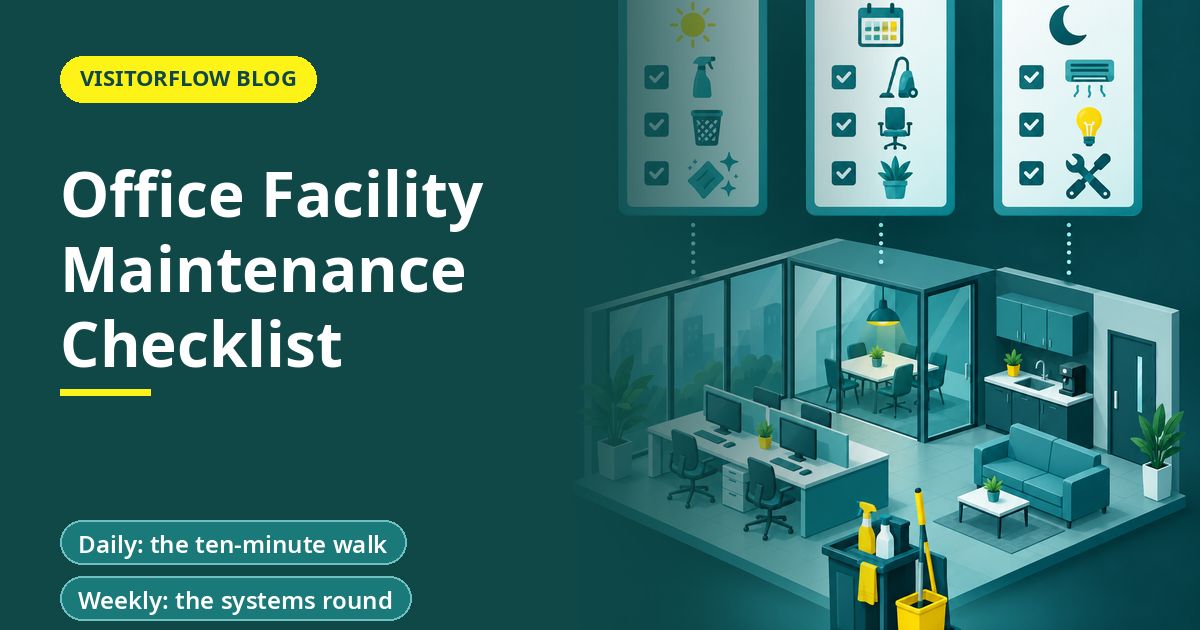
The Monday that goes wrong starts at 8:40 AM. The AC in the main conference room is dead an hour before the client presentation. The washroom on the third floor has been "getting fixed" since Thursday, which HR knows because employees have started emailing photos. The fire extinguisher near the server room is three months past its inspection tag, which nobody knows yet but the auditor next month will. None of these are surprises; every one of them was visible for weeks to anyone with a list. The facility did not lack effort or budget. It lacked the list, and on Monday morning the bill for that arrives all at once.
Office facility maintenance runs on cadence: some things need eyes daily, some weekly, some monthly, and the discipline is in matching each asset to its rhythm and making the checks provable. This guide gives you the working checklist by frequency, how to run it on a phone instead of a clipboard, and how to keep it alive past the first enthusiastic month. It builds on our preventive maintenance schedule template and our hospital maintenance guide, whose inspection discipline translates directly.
On this page
Daily: the ten-minute walk
The daily round is not maintenance; it is detection, and it should take one person ten minutes before the office fills up. Washrooms: water running, flush working, soap and tissue stocked, no leaks under basins. Common areas: lights working, AC blowing cold in meeting rooms (the client-presentation failure is found at 8:10, not 8:40), pantry equipment on, no wet-floor hazards. Safety glance: exits clear, extinguisher access unblocked, nothing stored in electrical rooms. Entry: gate, reception and visitor systems up. Anything found becomes a work order with a photo, not a mental note.
The walk's value is entirely in its timing and its proof. Ten minutes, every morning, before the doors fill: that is the entire investment the daily cadence asks for. Timed before occupancy, every problem it finds gets fixed before employees meet it; timed at noon, it is a list of things people already complained about. And it needs a record, because the daily walk that leaves no trace did not happen, as far as next month's incident review is concerned. The record also does something quieter: it turns the walk from a favour into a routine, and routines survive the week everyone is on leave.
Weekly: the systems round
The weekly round checks the systems that fail slowly and expensively. HVAC: filters inspected, unusual noise or smell noted, thermostat schedules verified (the AC running all weekend in an empty office is a utility-bill discovery). Electrical: DB rooms cool and clean, no warm breakers, no daisy-chained extension boards breeding under desks. Plumbing: pump operation, overhead tank levels, the slow leak behind the false ceiling that becomes next quarter's collapse. Housekeeping quality: scored against the checklist, not against the supervisor's mood. Pest control and plants: the two vendors everyone forgets have schedules. Keep the weekly round short enough to finish; a two-hour weekly round is a monthly round in disguise, and it will renegotiate itself accordingly.
One hour a week, same day, same route. The weekly round is also where the daily walk's findings get verified closed: the washroom reported Monday should not still be "getting fixed" on Friday, and the round is where that sentence gets challenged with a work-order status.
Monthly and quarterly: the deep checks
Monthly: DG set test-run under load (thirty minutes, fuel and battery logged), fire alarm and extinguisher inspection with the tag updated, lift service verified against the AMC visit, water tank and STP checks, UPS and server-room temperatures reviewed, and the pest-control and deep-cleaning vendor visits closed with checklists. Monthly is also when the compliance calendar gets its glance: which inspections, licenses and NOC-related checks fall due next month.
Quarterly: the full fire drill with the evacuation roll call timed, the electrical thermography or at least a tightening round, facade and waterproofing inspection before monsoon (the cheapest waterproofing inspection is the one before the rain), and the asset-register reconciliation: what moved floors, what got scrapped, what new equipment nobody registered. The quarterly checks are where the facility's slow risks live, and they are the first thing cut when the calendar gets busy, which is exactly why they need to fire automatically. A quarterly check that depends on someone's memory is a check that happens annually at best.
Making the checklist provable
The clipboard version of all this dies in a month, for a known reason: a tick on paper costs nothing and proves nothing. The phone version survives because it makes the work visible and the ticking expensive. Each check closes with a photo or a reading where proof matters (the DG hours meter, the extinguisher tag, the conference-room temperature), the supervisor sees the day's checklist complete itself in real time, and anything not closed by evening is on tomorrow morning's overdue list with a name on it. Findings convert to work orders in the same flow, so the leak found on the walk is a tracked ticket before the walker reaches the next floor.
The proof is not about distrust; it is about defensibility. When the auditor asks for fire-inspection records, when the landlord disputes a maintenance charge, when the Monday-that-went-wrong gets its post-mortem, the timestamped photo trail is the facility's answer. A checklist with proof is an asset; a checklist with ticks is a habit waiting to lapse. The photo trail is also what lets a new facility executive inherit the building's memory on day one.
The checklist that runs itself
VisitorFlow's maintenance helpdesk fires daily, weekly and monthly checklists to the right phone, with photo proof, overdue alerts and instant work orders.
Explore Maintenance HelpdeskKeeping it alive past month one
Every facility checklist dies the same death: enthusiastic launch, faithful fortnight, quiet fade. The three things that keep it alive are all structural. A named owner per cadence, so the daily walk belongs to someone specific each week rather than to everyone and therefore no one. A visible scoreboard, because completion percentage on a screen in the facility office outperforms any reminder email ever written. And a monthly five-minute review of the checklist itself: items that never find anything get questioned, items that keep finding things get promoted in frequency, and the new asset that arrived last month gets added before its first failure adds it for you.
The sign it is working is not a perfect completion rate; it is the complaint curve bending down. When employees stop emailing photos of washrooms, when the client presentation never meets a dead AC, when the auditor's extinguisher question gets a bored answer, the checklist has become what it was supposed to be: unremarkable, like every other piece of infrastructure that works.
Reader Q&A
Our facility is one floor. Do we need all three cadences?
Yes, scaled down. A single floor still has extinguishers with monthly tags, an AC with a filter schedule, and a washroom that deserves a daily glance. The checklist shrinks; the cadence logic does not change, because the failures do not scale with floor area.
Who should do the daily walk?
The earliest reliable person, rotated weekly to keep eyes fresh: facility executive, senior housekeeping staff, or the office admin. The rotation matters; the same walker for six months starts seeing the room they expect, and the checklist's whole value is noticing the unexpected.
How do we stop pencil-whipping on the phone checklist?
Photos with timestamps for the checks that matter, QR scans at the physical location for the ones that matter most, and a supervisor who spot-verifies one item a day at random. The message is not surveillance; it is that the record is real, which is what makes the record worth keeping.
What about vendor-run checks like lift and pest control?
They go on the same checklist as vendor-verification items: your person confirms the visit happened and the vendor's checklist was completed, and the AMC record gets the evidence. Our AMC management guide covers why your record, not theirs, is the one that matters at renewal.
How do employee complaints fit with the checklist?
Complaints are the checklist's safety net, not its replacement: QR codes around the office let anyone report in twenty seconds, and the complaint rate per zone is itself a metric. A rising complaint rate on floors the checklist covers means the checks are passing too easily.
When does monsoon prep go on the calendar?
Six weeks before the usual onset: terrace and waterproofing inspection, drain clearing, DG and sump-pump tests, and a sandbag-and-leak-kit check. The facilities that flood are not the ones without drains; they are the ones that inspected them in July.
Bottom line
This week, write your own three lists (daily, weekly, monthly) from a walk of your actual floors; the version in this guide is a starting point, your building's quirks are the rest. Then do the daily walk tomorrow at 8:10 and see what it finds before anyone complains.
This quarter, put the cadence on phones with photo proof and an overdue list, and review the closure numbers weekly. The Monday that goes wrong is never caused on Monday; it is caused by the three quiet weeks before it, and the checklist is how you spend those weeks instead of paying for them.
Spend the quiet weeks
VisitorFlow's maintenance helpdesk runs your daily, weekly and monthly rounds with proof, alerts and instant work orders, so nothing waits for a complaint.
Explore Maintenance Helpdesk See Visitor Management Book a Free Demo
Aadeshwar Modi is a marketing technical content writer who loves writing on technology and AI topics.
- From Register Book to Software: Digitizing the Gate Pass
- Inter-Branch Transfer Gate Pass: Keep Stock True Across Units
- Material Inward Gate Pass: Link the Gate with the GRN
- E-Way Bill vs Gate Pass: What Each Document Does
- Gate Pass System for Engineering and Fabrication Workshops
- Gate Pass Software for Pharma and Chemical Plants
- Breakdown Maintenance Log: Record, Analyze, Reduce
- Maintenance KPIs and Dashboards: What to Review Weekly
- AMC Management Software: Contracts, Renewals and Vendor SLAs
- Spare Parts Management Software for Maintenance Teams