From Register Book to Software: Digitizing the Gate Pass
Published on 10/21/2026 • Updated on 10/22/2026
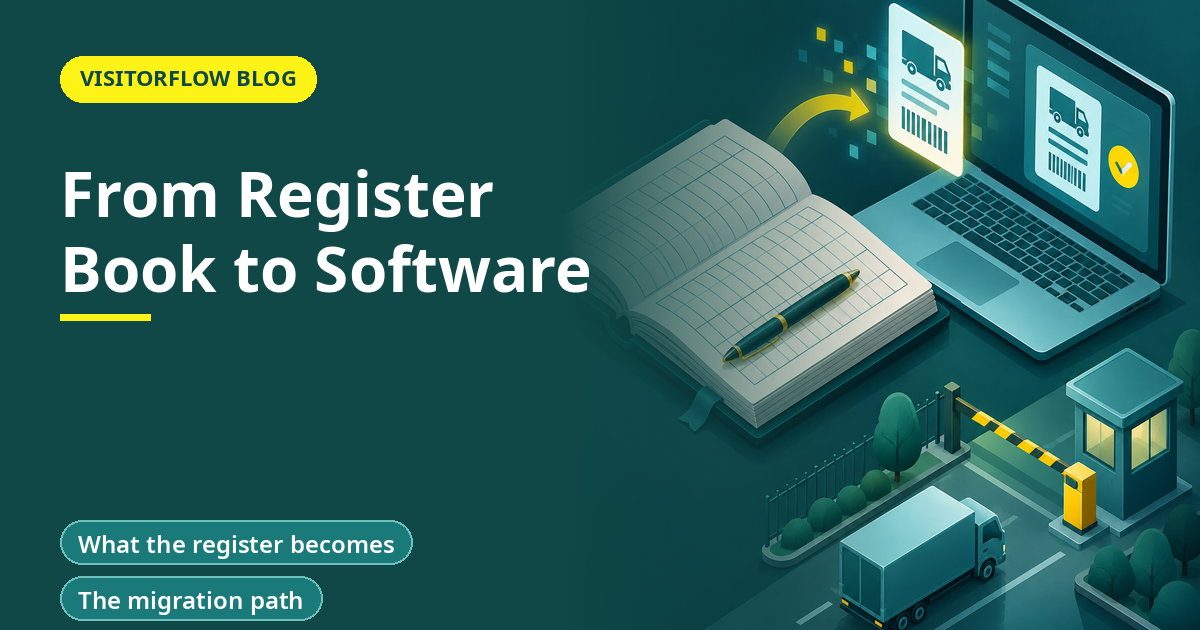
Every factory in India has one: the gate pass register, a fat ruled book at the security cabin, its carbon copies flaking, its columns drifting, its handwriting ranging from careful to archaeological. It has survived three security supervisors and two ERP implementations, and it is still the only place where "what left the plant on the 14th" has any answer at all. Then someone asks the register a slightly harder question (all the returnable passes still open against vendor X, or every laptop that left with employees this quarter) and the book's limits arrive at once: it can only be read one page at a time, by one person, standing at the gate, hoping the ink survived the monsoon. The register was never a bad tool. It was a good tool asked to answer questions it cannot hear.
Digitizing the gate pass register is the smallest software project in a factory and often the fastest payback. This guide covers what the register becomes when it moves to software, how to migrate without disturbing the gate, the questions the digital register answers that the book cannot, and how to choose between the Excel step and the full system. It builds on our gate pass Excel format guide and our gate pass software comparison.
On this page
What the register becomes
The digital register keeps everything the book did (the pass number, the material, the who and when) and removes the four failures baked into paper. Legibility: every entry is typed and complete, because mandatory fields do not accept half a row. Search: any question is a filter, not an afternoon. Multiplicity: the register exists at the gate, on the manager's phone and in the auditor's export simultaneously, without photocopying. And permanence: no water damage, no missing book, no carbon copy that stopped copying in 2019.
But the bigger change is that the register stops being a passive record and becomes an active one. The book knows what happened; the system knows what is still open. Every returnable pass carries its expected return date and goes red when it lapses. Every approval happens before the pass exists, not as a signature chased after. The register graduates from describing the past to guarding the present, which is the difference between a record and a control. A record helps you explain the past; a control changes what happens next Friday at 6 PM.
What the book cannot answer
Question 01
What is still out?
Open returnables, with ages, per vendor and per item. The book can answer this with a full read of every page since January; the system answers it while the phone is still waking up. This one question usually justifies the entire project, because the answer is always worth money.
Question 02
Who approved this?
Every pass carries its approval chain: who raised, who approved, when, from where. The book's squiggle becomes a name with a timestamp, and the shrinkage investigation stops being a handwriting contest.
Question 03
Show me the pattern
Exits by vendor, by material, by hour of day, by approver. Patterns are invisible in a sequential book and obvious in a filtered view; the Friday-evening spike in exits and the one vendor whose loads always gate out at shift change both surface in the first month.
Question 04
Prove it to the auditor
A filtered export with every field intact: the ISO, IATF or customer-audit sampling question answered in a minute. The book's version of this is a godown shelf and a prayer; the system's version is a file.
The migration path
The migration that works does not migrate history at all. The book stays as the archive; the system starts from a clean pass-number series on go-live day. Week one is configuration: pass types (returnable, non-returnable, employee belongings), approval chains per type, vendor and material lists. Week two is the parallel run: the system live at the gate, the book still open as comfort, and by Friday the book is visibly the slower of the two. Week three the book closes, and nobody mourns it, because the gate has already discovered that the system is faster than the pen.
Two details decide whether week two succeeds. The guard's screen must be simpler than the book: big fields, dropdowns instead of handwriting, a camera for the load photo, and nothing else. And the approvers must approve from their phones, because the whole point is that the approval no longer depends on who is physically near the cabin. Get those two right and the register's hundred-year run ends without ceremony.
Excel step or full system
The honest middle step is an Excel register on the gate computer, and our Excel format guide gives a working template. It fixes legibility and search, costs nothing, and teaches the gate the digital habit. It does not fix approvals (still a signature hunt), openness (still no returnable tracking unless someone maintains the formula), multiplicity (the file lives on one machine, one corrupt save from oblivion), or proof (any cell can be retyped without a trace). For a single low-traffic gate it can be the right answer for a year.
The full system earns its cost the moment any of those four gaps matter: approvals before the pass exists, returnables that flag themselves, a register that survives a hard-disk death, and an audit trail that proves a row was not rewritten. Most plants reach that moment within a quarter of the Excel step, and reach it informed, which is the best way to arrive. The Excel year's other gift is a clean, typed history that imports straight into the system on day one, so the step is never wasted effort. The comparison guide walks the full feature-by-feature evaluation when you get there.
Retire the book, keep the answers
VisitorFlow turns the gate register into a live system: approvals, returnable tracking, photos and audit-ready exports from day one.
Explore Material Gate Pass SoftwareThe first quarter without the book
Month one is the novelty month: the guard learns the screen, the approvers learn their phones, and the first returnable goes red on the dashboard, causing a small stir and a recovered fixture. Month two is the habit month: the parallel-run comfort ends, the book formally closes, and the Friday-afternoon exits now carry photos because the system made it easier than skipping them. Month three is the payoff month: the first pattern report lands in the review meeting, the first auditor question gets a one-minute answer, and someone says the sentence every digitization project aims for: "how did we run the gate before this".
The metric to watch through the quarter is pass cycle time: from request to approved pass. The book's version measured in tens of minutes with legwork; the system's version settles in the low single digits, and every minute of that difference is gate queue, driver detention and supervisor time that comes back permanently.
Reader Q&A
Do we lose the old register's data?
No; the book retires intact as the archive, and truly important open items (outstanding returnables on go-live day) are entered as opening balances. Re-typing history is a month of work to answer questions that will be asked twice; the open items are the only history that still has a future.
Our guard is not computer-savvy. Will this work?
The gate screen is designed for exactly this user: dropdowns, big buttons, one camera tap, and a pass that prints itself. Guards who never typed in their lives run it within a day, because it is genuinely easier than the book; the training that matters is the approvers', and theirs is a phone app.
What happens when the internet or power goes down?
The gate keeps working offline: entries queue on the device and sync when connectivity returns, with the true timestamps preserved. The fallback kit is still worth having (a pre-numbered paper pad for the genuinely long outage), but the day-to-day flickers never touch the register.
Can we keep our existing pass format and numbering?
Yes; the printed pass mirrors your current format, logo and all, and the number series can continue from the book's last number. The gate's customers and drivers should notice nothing except that the handwriting improved.
What does the auditor actually ask for?
A sample: "all material exits in March for this vendor" or "this pass number and its approvals". The export answers both in a minute with every field and the approval trail intact. The audit opinion on a digital register with integrity controls is consistently better than on a book, because completeness is provable.
How long is the payback?
Usually the first open-returnables report. One recovered fixture, one vendor claim won with evidence, one audit finding avoided: any of these typically exceeds the year's subscription. The register is the cheapest digitization in the plant because the book was already the bottleneck.
Bottom line
This week, ask your register the four questions: what is still out, who approved a specific pass, the pattern by vendor, and a one-month export for a hypothetical auditor. The ones it cannot answer are the business case, and they cost nothing to discover.
This quarter, take the step that fits: the Excel register if the gate is quiet, the full system the moment approvals, returnables or audit-proofing matter. The book served for a hundred years; its retirement should be the best-run project on the site, not the hardest.
The register, upgraded
VisitorFlow replaces the gate book with a system that answers every question the book cannot, live from day one.
Explore Material Gate Pass Software See Visitor Management Book a Free Demo
Aadeshwar Modi is a marketing technical content writer who loves writing on technology and AI topics.
- Inter-Branch Transfer Gate Pass: Keep Stock True Across Units
- Material Inward Gate Pass: Link the Gate with the GRN
- E-Way Bill vs Gate Pass: What Each Document Does
- Gate Pass System for Engineering and Fabrication Workshops
- Gate Pass Software for Pharma and Chemical Plants
- Office Facility Maintenance Checklist: Daily, Weekly, Monthly
- Breakdown Maintenance Log: Record, Analyze, Reduce
- Maintenance KPIs and Dashboards: What to Review Weekly
- AMC Management Software: Contracts, Renewals and Vendor SLAs
- Spare Parts Management Software for Maintenance Teams