E-Way Bill vs Gate Pass: What Each Document Does
Published on 10/21/2026 • Updated on 10/22/2026
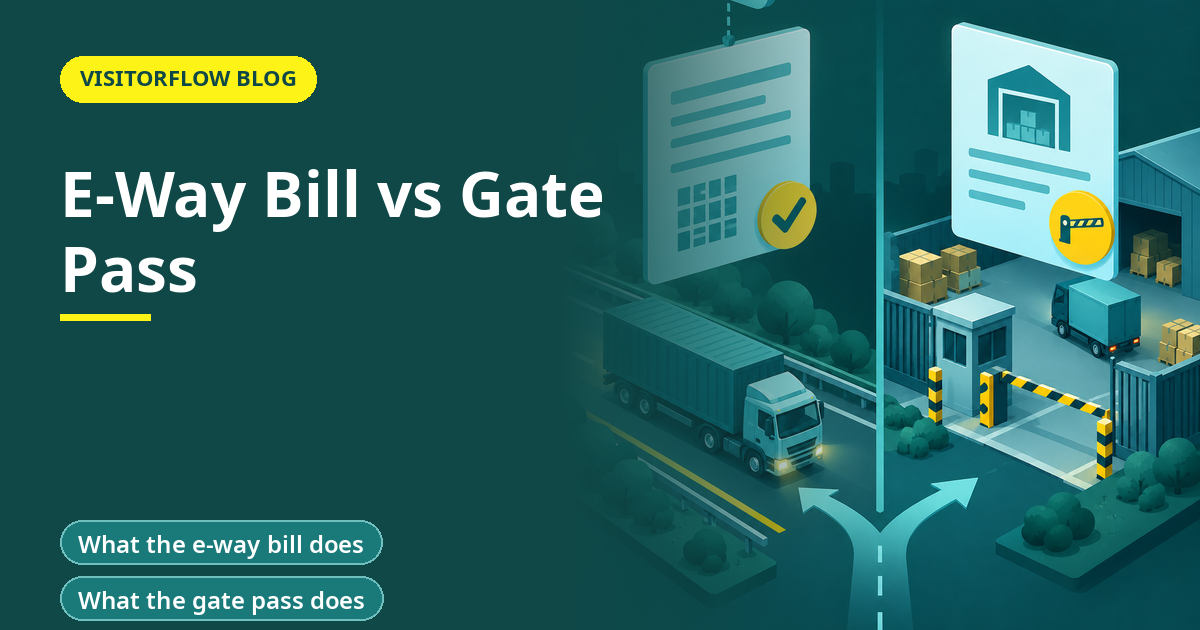
A plant's dispatch sends out a truck with a perfect e-way bill and gets a surprise call from the CFO a week later: the customer's security team claims the consignment never matched what arrived, and the plant has nothing to say back, because the e-way bill proves the truck left with tax compliance and nothing else. No approval trail for who released the material, no gate-out timestamp, no photo of the loaded vehicle, no record of which pass authorized the movement. The tax department was fully satisfied. The plant's own control system was not in the vehicle at all. The two documents were never the same job; the plant just treated one as a substitute for the other.
The e-way bill and the gate pass get confused constantly because both travel with material and both get checked at boundaries. But they answer different questions for different masters, and a plant that runs only one of them is exposed on the other side. This guide draws the line precisely: what each document does, where each is legally required, how they work together at the gate, and how to set up a flow where neither is skipped. It pairs with our delivery challan vs gate pass GST guide and our gate pass explainer.
On this page
What the e-way bill does
The e-way bill is the GST system's document: it tells the tax authority that a movement of goods above Rs 50,000 is declared, with the consignor, consignee, goods description, value and vehicle on a government portal. Its master is the tax department; its check happens on the highway, where a GST officer can stop the vehicle and demand the EWB number; and its absence has a statutory cost: detention of the vehicle and penalties under the GST Act.
Notice what the e-way bill does not do. It does not prove your company authorized the movement; anyone with portal credentials can generate one. It does not record who approved the release, what time the vehicle crossed your gate, or what condition the material was in. It has no returnable tracking, no partial-receipt logic, and no interest in material moving inside your premises or below its value threshold. It is a tax document doing a tax job, and it does that job well. The mistake is asking it to also do your company's job, which it was never designed to know about.
What the gate pass does
The gate pass is the plant's own document: it says this movement was authorized, by this approver, of this material, out of this gate, at this time. Its master is the company; its check happens at your own gate, where security verifies the physical load against the approved pass; and its absence has a control cost: material that leaves without a pass is material your own system did not release, which is the opening scene of every shrinkage investigation.
The gate pass carries what the e-way bill never will: the internal approval chain, the returnable-versus-non-returnable status with closure tracking, the linkage to the work order or delivery challan that justified the movement, and the gate-out evidence (timestamp, vehicle photo, security sign-off). It also covers everything below the EWB threshold and every internal movement the GST system does not know exists. When the customer dispute or the internal audit arrives, the gate pass is the document that answers. This is also why the pass outlives the EWB in usefulness: the tax question closes when the truck is accepted, but the authorization question can reopen years later in an audit.
Side by side: the exact differences
| Question | E-way bill | Gate pass |
|---|---|---|
| Who requires it? | GST law, for movements above Rs 50,000 | Your own controls, for any material crossing the gate |
| Where is it checked? | On the road, by tax officers | At your gate, by your security |
| What does it prove? | The movement was declared for tax | The movement was authorized by you |
| Approval trail? | None; portal credentials suffice | The core of the document: who approved, when, why |
| Returnables and partials? | No concept of them | Built in; open balances tracked to closure |
| Cost of skipping it | Vehicle detention, tax penalties | Shrinkage you cannot investigate, disputes you cannot win |
Running both at one gate
The working flow treats the two documents as a pair with one trigger. Dispatch raises the gate pass; the approval chain runs; for movements above the threshold, the EWB number goes onto the pass (typed or synced from the portal), so the pass becomes the single document the gate verifies. Security checks the load against the pass, confirms the EWB number where one is required, and gates out with a timestamp. One stop, both obligations discharged, and the pass carries both proofs into the record. The highway officer checks the EWB; your auditor checks the pass; the same gate-out event satisfies both.
The failure modes to design against are the two asymmetries. EWB without a pass: material released on tax compliance alone, with no internal authorization; fix by making the gate's rule "no pass, no exit" regardless of what rides with the truck. And a pass without the EWB where one is required: the truck gets detained on the highway and the customer hears about it before you do; fix by making the EWB field mandatory on the pass for above-threshold movement types, so the omission is impossible at print time. Both fixes are configuration, not vigilance, which is why they survive staff changes and Friday evenings.
One gate, both documents, zero gaps
VisitorFlow gate passes carry the EWB number where GST requires it, with approvals, returnable tracking and gate-out proof built in.
Explore Material Gate Pass SoftwareThe roles that own each
Confusion between the two documents is often really confusion about ownership. The e-way bill belongs to accounts or dispatch coordination: they hold the portal credentials, they answer for its correctness, and they hear from the tax officer if it is wrong. The gate pass belongs to the function that owns the material: stores for raw material and spares, production for job work, dispatch for finished goods, admin for assets. Security enforces at the gate but owns neither document; their job is the verification, and both documents must reach them in a form they can check in under a minute.
Writing the ownership down ends the two classic stalls: dispatch assuming stores raised the pass while stores assumed dispatch did, and everyone assuming the EWB someone else generated is somehow the company's authorization. One page of SOP (who raises, who approves, who verifies, for each movement type) is most of the implementation, and the software simply enforces what the page says.
Reader Q&A
Is a gate pass legally required like the e-way bill?
Not by statute; by sense. No law forces you to authorize your own material movements, but every audit framework (ISO, IATF, GMP), every insurer and every shrinkage investigation expects you to have. The e-way bill is compulsory; the gate pass is indispensable, which is different and not smaller.
Can the e-way bill double as our gate pass?
Only for above-threshold sales dispatches, and even there it lacks your approval chain, returnable tracking and gate-out evidence. For everything else (job work, transfers, repairs, scrap, below-threshold moves) it does not exist at all. Use it as a field on the pass, not as the pass.
Do internal movements between our own units need both?
Above the threshold, yes, stock transfers between distinct GST registrations need an EWB with a delivery challan; and they need a gate pass too, because "it went to our own unit" is exactly the movement internal controls forget until the stock does not tally. Our inter-branch transfer guide covers the paired flow.
What about material below Rs 50,000?
No EWB required, which is precisely why the gate pass matters more there: below the threshold there is no government record of the movement at all, so your pass is the only proof the movement was authorized. Small consignments are where shrinkage hides.
Does the driver need to carry both?
The driver needs the EWB (number on phone suffices for the highway check) and the delivery documents; the gate pass is your document and lives in your system, though printing a copy for the customer's gate smooths entry at the far end. Pairing the EWB number on the pass keeps the two tied together for any later question.
How do e-invoice, e-way bill and gate pass fit together?
Three layers: the invoice is the commercial record, the e-way bill is the tax movement declaration, the gate pass is your authorization and exit evidence. Large dispatches carry all three; the gate pass is the only one that exists for every movement type, which is why it is the spine.
Bottom line
This week, audit one week of exits: for each truck, was there a pass, was there an EWB where required, and can you find both in under a minute? The pattern of which one goes missing tells you which side of the gate is exposed.
This quarter, pair them by design: the pass mandatory for every exit, the EWB field mandatory on the pass for above-threshold moves, one verification stop at the gate. The tax department has its document; make sure your company has its own.
Your document, not just the government's
VisitorFlow runs the gate pass half of the pair: approvals, EWB field, returnables, and gate-out evidence on every movement.
Explore Material Gate Pass Software See Visitor Management Book a Free Demo
Ed Jhonson is a Sourcing & Marketing Expert who writes content related to Technology and Engineering topics.
- From Register Book to Software: Digitizing the Gate Pass
- Inter-Branch Transfer Gate Pass: Keep Stock True Across Units
- Material Inward Gate Pass: Link the Gate with the GRN
- Gate Pass System for Engineering and Fabrication Workshops
- Gate Pass Software for Pharma and Chemical Plants
- Office Facility Maintenance Checklist: Daily, Weekly, Monthly
- Breakdown Maintenance Log: Record, Analyze, Reduce
- Maintenance KPIs and Dashboards: What to Review Weekly
- AMC Management Software: Contracts, Renewals and Vendor SLAs
- Spare Parts Management Software for Maintenance Teams