Inter-Branch Transfer Gate Pass: Keep Stock True Across Units
Published on 10/21/2026 • Updated on 10/22/2026
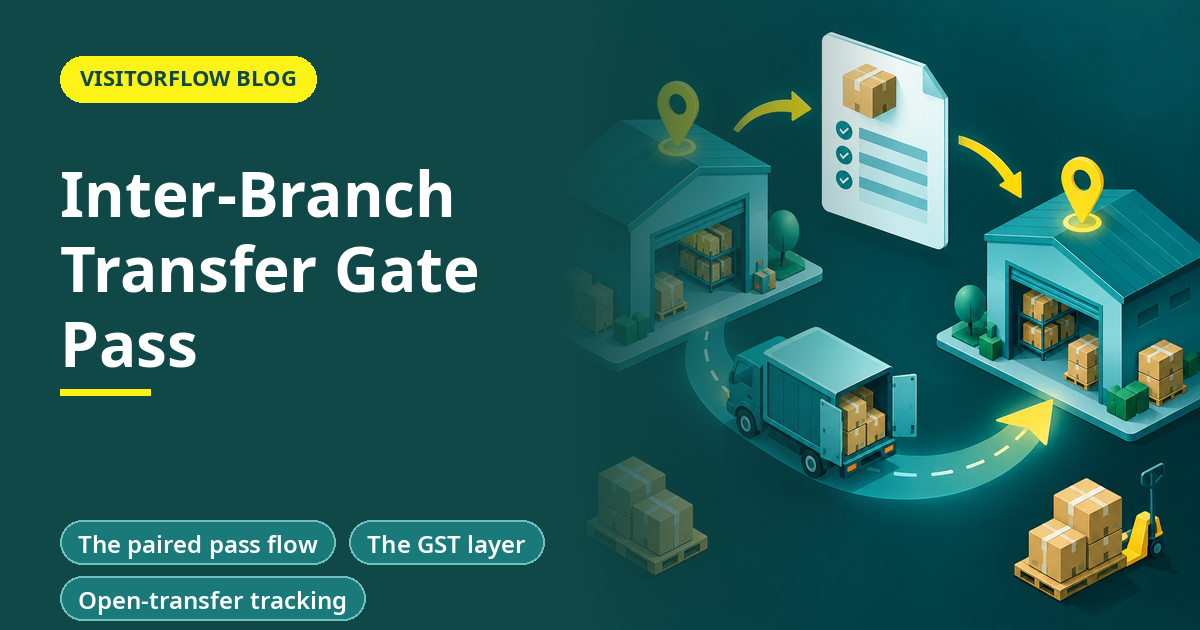
The stock reconciliation at a three-plant company finds 14 tonnes of raw material that exists on no plant's books. Not stolen; moved. Over the year, the plants shifted material between each other dozens of times to cover production gaps, each move arranged on a phone call, recorded at neither gate, and invoiced at neither end because "it is all our own company". The GST consultant's face does the arithmetic first: stock transfers between distinct GST registrations need delivery challans and e-way bills, and a year of undocumented transfers is a year of exposure. The operations head's arithmetic is worse: nobody actually knows which plant has the 14 tonnes. Material moving between your own units is the most trusted traffic at your gates, and trust is not a control.
Inter-branch transfers fail quietly because both gates assume the other is recording. This guide covers why internal movement needs the same rigor as external, the paired gate pass flow (out at one unit, in at the other), the GST documents that ride along, and the open-transfer tracking that keeps stock true across plants. It builds on our returnable gate pass guide and our RGP vs NRGP comparison.
On this page
Why internal movement leaks
External movements get documents because a stranger is involved; internal movements get phone calls because everyone is family. That asymmetry is the whole problem. The sending gate waves the truck through on a verbal OK because the destination is "our own unit". The receiving gate accepts whatever arrives because the driver has a familiar logo on the truck. Neither creates a record, both assume the other did, and the stock ledgers diverge by the amount of the goodwill. Six months later the reconciliation has to choose between two wrong books, and it usually splits the difference, which is accounting for "we do not know".
The leak is also where actual theft hides. A truck with the company logo and a confident driver is the least inspected vehicle at any gate, and every internal-audit case study of plant theft eventually features one. The fix is not suspicion; it is symmetry: the same document discipline for a movement to your own unit as for a movement to a customer, because the material does not know the difference. The symmetry also has a cultural payoff: when the internal truck gets the same courteous check as the customer's truck, the check stops reading as suspicion and starts reading as how this company works.
The paired pass flow
Step 01
One transfer order, raised once
The transfer starts as a single record: sending unit, receiving unit, material, quantity, reason, and the approvals on both sides. Both plants work from the same record; the phone call becomes a notification, not the source of truth. When both plants read the same record, the classic quarrel over what was agreed has nowhere to live.
Step 02
Out-pass at the sending gate
The sending unit's gate verifies the load against the approved transfer, records vehicle and timestamp, and the transfer moves to "in transit". The sending stock ledger decrements the same minute, not at month-end. That timing change alone is what makes the receiving gate's count meaningful, because the expectation was set before the truck arrived.
Step 03
In-pass at the receiving gate
The receiving gate sees the expected transfer on its list, counts against it, notes differences with photos, and closes the transfer. The receiving ledger increments, and any shortage is a same-day exception between two named gates, not a quarter-end mystery between two ledgers. The receiving count also closes the loop for the sender: their ledger is finally decremented by what actually arrived, not by what was waved out.
The GST layer
"Own company" is not a GST exemption. Units under different GSTINs (different states, or separately registered units) are distinct persons in the law's eyes, and stock transfers between them are taxable events: they travel with a delivery challan or a tax invoice depending on structure, and an e-way bill above the threshold, exactly as if the other unit were a customer. The 14-tonne story's first problem was discovered by the GST consultant for a reason; the tax exposure accumulates silently per truck until someone adds it up.
The paired pass flow carries the GST layer as fields: the delivery challan number and the e-way bill number live on the transfer record, mandatory when the sending and receiving GSTINs differ. Same-GSTIN internal moves (two sheds, one registration) skip the tax documents but keep the pass, because the stock-truth problem is identical either way. The rule that survives audits is simple: tax documents follow the GSTIN boundary, the pass follows the physical boundary, and every truck crosses at least one of them. Our delivery challan vs gate pass guide draws the document boundaries precisely.
Open-transfer tracking
The report that keeps the system honest is the open-transfer list: transfers gated out but not yet gated in, with ages. A two-hour plant-to-plant run showing as open for six days is a truck that went somewhere, and the list makes it a phone call on day one instead of a finding on day ninety. Returnable transfers (moulds, fixtures, returnable packaging circulating between units) work the same way with longer expected windows; the returnable logic from our RGP guide applies unchanged.
Month-end then stops being a negotiation. Both plants' ledgers reconcile against the transfer records instead of against each other's memories, shortages are already resolved as same-day exceptions, and the head-office view shows every unit's true stock without a reconciliation project. The 14-tonne class of surprise becomes structurally impossible, because every tonne is on exactly one record at every moment: a plant, or an open transfer with an age. That single invariant, checked weekly, is worth more than any reconciliation project ever run at quarter-end.
One transfer, two gates, one record
VisitorFlow pairs the out-pass and in-pass on a single transfer record, with e-way bill fields and open-transfer ageing built in.
Explore Material Gate Pass SoftwareRolling out across units
Start with the busiest route, not the whole network. The two units that trade material every week feel the benefit first (the phone calls stop, the reconciliation starts), and their success becomes the internal case study for the rest. The first week runs both systems: the paired pass live, the old phone-call habit tolerated but recorded after the fact. The second week, the route's rule hardens: no transfer record, no gate-out. Because the pass takes less time than the phone call it replaces, compliance arrives without a fight.
Two things make the multi-unit rollout stick. Templates for the regular routes (material, quantity bands, both approvers pre-set), so a routine transfer is thirty seconds of work. And a monthly cross-unit review of the open list and the exceptions, run by head office, because the units themselves see only their own gate; someone has to watch the space between the gates, which is exactly where the 14 tonnes lived.
Reader Q&A
Our units share one GSTIN. Do we still need passes?
Yes, because the tax layer was never the main reason. The pass is what keeps each unit's stock true and what makes the company-logo truck an inspected vehicle. The GST documents fall away for same-GSTIN moves; the control case stands on its own.
Who approves an inter-branch transfer?
Both sides, because both stocks change: the sending unit's stores or production head releases, the receiving unit's head accepts the expectation. Two approvals sounds heavy until the alternative is two ledgers that disagree; in the app it is two taps.
What if the receiving unit counts less than what was shipped?
The transfer closes partial, and the difference opens as an exception with photos from both gates. That is the system working: the shortage is a named, dated, evidenced event between two specific gates, resolvable while the transporter is still findable.
How do returnable items between units work?
As transfers marked returnable, with the expected return window; the return leg closes quantity against the open record. Moulds and fixtures that circulate all year finally get a where-is-it answer at any moment, and the open list doubles as the utilization report.
Does head office get a view across units?
Yes; the transfer register rolls up across all units with in-transit ages and exception flags. Head office stops reconciling spreadsheets over WhatsApp and starts reading a screen, which is the same information with the argument removed.
Will this slow urgent transfers between plants?
The urgent case is the strongest case for it: the approval is a tap on each side, the gate check is a minute, and the alternative (a fast, undocumented move) is precisely how the 14-tonne year happens. Speed comes from pre-approved templates for regular routes, not from skipping the record.
Bottom line
This week, ask both ends of your most frequent inter-unit route for last month's transfer count. If the two numbers disagree, you have the problem; if they agree, ask how long the answer took, because that is the other half of the problem.
This quarter, move transfers to the paired flow: one record, both gates, the GST fields where the GSTINs differ, and the open list reviewed weekly. Your own units deserve the same rigor as your customers, because the stock ledger cannot tell them apart.
No more friendly unrecorded trucks
VisitorFlow tracks inter-unit material from out-pass to in-pass on one record, with GST fields and open-transfer ageing across all your plants.
Explore Material Gate Pass Software See Visitor Management Book a Free Demo
Ed Jhonson is a Sourcing & Marketing Expert who writes content related to Technology and Engineering topics.
- From Register Book to Software: Digitizing the Gate Pass
- Material Inward Gate Pass: Link the Gate with the GRN
- E-Way Bill vs Gate Pass: What Each Document Does
- Gate Pass System for Engineering and Fabrication Workshops
- Gate Pass Software for Pharma and Chemical Plants
- Office Facility Maintenance Checklist: Daily, Weekly, Monthly
- Breakdown Maintenance Log: Record, Analyze, Reduce
- Maintenance KPIs and Dashboards: What to Review Weekly
- AMC Management Software: Contracts, Renewals and Vendor SLAs
- Spare Parts Management Software for Maintenance Teams