Material Inward Gate Pass: Link the Gate with the GRN
Published on 10/21/2026 • Updated on 10/23/2026
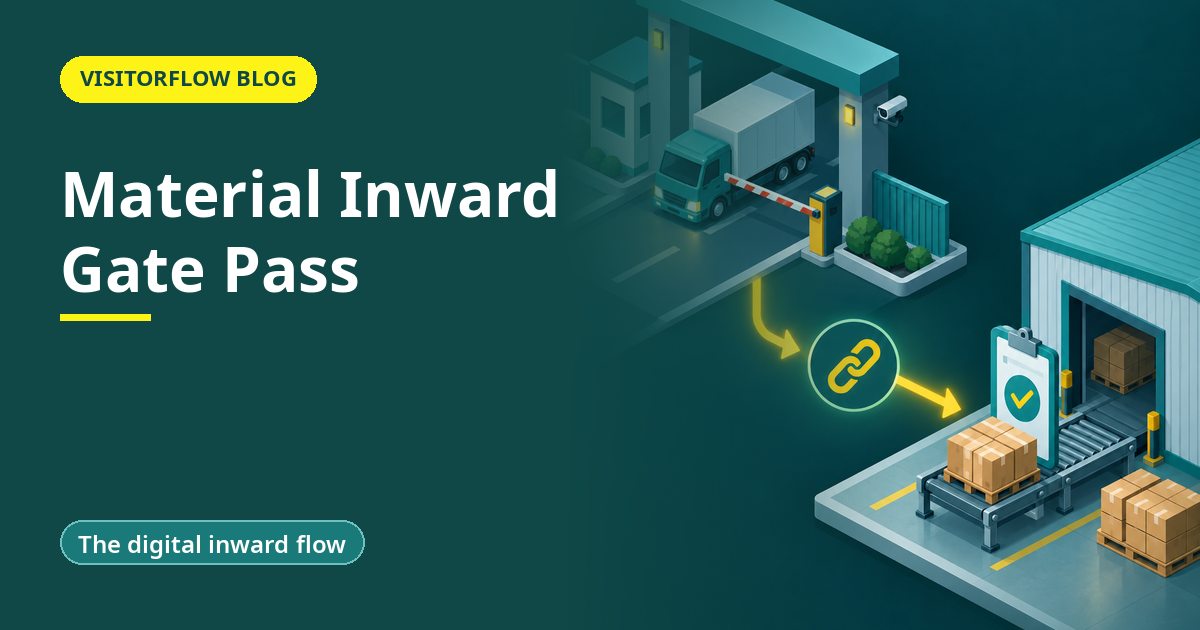
The invoice says 500 boxes. The supplier's delivery challan says 500 boxes. The security register says a truck came at 11:40. The stores bin has 480. Somewhere between the invoice and the bin, twenty boxes became a rounding error that nobody can explain, and the purchase team will pay for 500 because every document they can produce says 500. The truck driver, the security guard, the unloader and the stores assistant all did their jobs; the jobs simply never compared notes at a single point. Inward material control is the moment the plant agrees, in writing, on what actually crossed the gate, and the plants that skip that moment discover the skip at every reconciliation.
The inward gate pass (or inward entry) is the least glamorous half of gate management and the half where the money leaks. This guide covers what the inward record must capture, how it links to the PO and the GRN, how to handle the short-supply and damage cases, and how a digital inward flow changes the stores' daily reality. It builds on our inward-outward register format guide and our material movement software overview.
On this page
What the inward record must capture
Field 01
The vehicle and the arrival
Vehicle number, driver, supplier name, gate-in timestamp. The timestamp alone settles detention disputes, and the vehicle number is what the CCTV pulls up when the box count is questioned three weeks later.
Field 02
The document references
Supplier's delivery challan number and your PO number, captured at the gate, not reconstructed later. These two numbers are the hooks every later reconciliation pulls on; an inward entry without them is a memory, not a record.
Field 03
Counted quantity versus claimed quantity
Both numbers, separately. The challan says 500; the gate or stores count says what physically arrived; the record keeps both and flags the difference. Collapsing them into one number is exactly how the twenty boxes disappear on paper while arriving nowhere in fact.
Field 04
Condition and photos
Damage, wet cartons, broken seals: noted at the gate with a photo, before the material disperses into the stores. The condition note is what converts a later quality argument into a same-day supplier claim, because the evidence predates the unpacking.
Linking PO, challan and GRN
The inward entry is the hinge between three documents that usually live in three silos: the purchase order (what you agreed to buy), the delivery challan (what the supplier claims to have sent), and the goods receipt note (what stores accept into stock). When the inward record carries both the PO and challan numbers, the three-way match that finance performs at invoice time stops being archaeology. Discrepancies surface the same day, while the truck is theoretically still contactable, instead of at month-end when the only evidence is everybody's recollection.
The sequence matters: the inward entry happens at the gate, the GRN happens at stores after counting and QC where applicable, and the two are different records on purpose. The gate record answers "what physically entered the premises and when"; the GRN answers "what we accept into stock and owe for". Plants that let the GRN double as the gate record lose the gate timestamp and the condition evidence; plants that let the gate register double as the GRN lose the QC and acceptance logic. Linked but separate is the whole design. The link is what lets finance trace an invoice back to a gate timestamp in one query; the separation is what keeps each record honest to the moment it describes.
Short supply, damage and disputes
The twenty missing boxes resolve in one of three directions, and the inward record decides which one is available. If the gate count showed 480 with the driver's acknowledgement, the claim against the supplier is a formality: the evidence was made at the moment of handover. If nobody counted, the claim becomes a negotiation between two memories, which is the kind of negotiation the supplier's memory usually wins. And if the material arrived damaged and nobody photographed it at the gate, the transporter, the supplier and your own stores can each plausibly blame the others, which means you pay.
The discipline is small and absolute: discrepancies and damage are recorded before the vehicle leaves, with the driver's or the delivery person's acknowledgement on the record. It adds two minutes to the gate and removes the entire category of unprovable claims. The plants that run it report the same side effect: suppliers' packing and counting improve within a quarter, because errors stop being free. The claim that lands the same day with a photo and an acknowledged count is not a dispute; it is an invoice adjustment waiting to happen.
The digital inward flow
Digitally, the flow tightens without slowing. The gate selects the supplier and PO from the list (no handwriting, no spelling variants), the challan number and count go in, photos attach from the gate phone, and the entry notifies stores that a truck is waiting with its expected contents already on screen. Stores counts against the expectation, QC pulls samples where the item requires it, and the GRN closes the loop with the inward entry linked. Purchase sees the receipt against the PO without calling anyone; finance's three-way match assembles itself.
The daily reports change character too: today's arrivals with discrepancy flags, supplier-wise short-supply history, average gate-to-stores time. The supplier with a pattern of 2 percent shortfalls stops being a suspicion and becomes a number in the vendor review. Our material gate pass software overview covers how inward and outward halves share one system; the inward half is where most plants feel the difference first.
Count it at the gate, not at the audit
VisitorFlow links PO, challan and GRN on one inward record, with gate counts, condition photos and discrepancy flags.
Explore Material Gate Pass SoftwareThe first month of running it
Week one is configuration, not data entry: supplier list, PO references, which items need QC, and ten minutes of gate training. The first real week of running produces the first surprise in almost every plant: discrepancies were always there, roughly one in ten receipts, and they were previously absorbed invisibly by stores. Week two, the acknowledgement habit forms, because the driver signs the count on the spot and suppliers hear about shortfalls the same day. By week four the supplier-wise short-supply report exists for the first time, and it usually reorders everyone's assumptions about which supplier needed watching.
The measure to watch is not the entry count; it is the claim rate. When supplier claims get raised the same day with photos and acknowledged counts, and get settled without a negotiation, the inward record has become what it was meant to be: the moment the plant's memory and the truck part company on agreed terms.
Reader Q&A
Is an inward gate pass needed if we already make a GRN?
Yes, because they answer different questions. The GRN is an acceptance record made later at stores; the inward entry is the arrival record made at the gate with the vehicle, the timestamp and the condition evidence. The gap between them (material waiting, QC hold, partial acceptance) is invisible without both.
Who counts at the gate, security or stores?
Design it by volume: low-traffic gates can have stores count at the gate before unloading; high-traffic gates record the vehicle and challan at the gate and count at the unloading bay with the same entry open. The rule that matters is not who counts but that the count and the claimed quantity both land on one record.
How do we handle courier and parcel deliveries?
Same record, lighter flow: courier name, tracking or docket number, parcel count, recipient department. Parcels are the most commonly pilfered inbound category precisely because they feel too small for the register; the twenty-second entry is the whole fix.
Does this slow down the gate during truck surges?
It speeds it up: the supplier and PO are picked from lists, the challan number is one field, and photos are a tap. The paper version of the same rigor (two registers, duplicate challans, phone calls to stores) is what actually queues the trucks.
How does QC fit between the gate and the GRN?
The inward entry flags QC-required items; material moves to the QC hold area, and the GRN cannot close until QC clears or rejects its quantity. Rejected material gets its own outward pass back to the supplier, linked to the original inward entry, so the loop closes on one thread.
Can suppliers pre-notify deliveries?
Yes; an advance-shipping notice against the PO lets the gate expect the truck, and the arrival becomes a confirmation instead of a data-entry session. Pre-notification also powers the daily expected-arrivals list, which is how stores stops being surprised by its own day.
Bottom line
This week, pick last month's largest receipt and assemble its full story: PO, challan, gate record, GRN, invoice. The time it takes and the gaps you find are the cost of the current flow, measured once so you never measure it again.
This quarter, move the inward record to the gate with counts, conditions and document references, linked to the GRN. The twenty boxes are always explainable at 11:40; the inward entry is how you still have the explanation at month-end.
Every box has a paper trail
VisitorFlow runs the inward flow from gate to GRN: counts, conditions, document links and discrepancy flags on one record.
Explore Material Gate Pass Software See Visitor Management Book a Free Demo
Aadeshwar Modi is a marketing technical content writer who loves writing on technology and AI topics.
- From Register Book to Software: Digitizing the Gate Pass
- Inter-Branch Transfer Gate Pass: Keep Stock True Across Units
- E-Way Bill vs Gate Pass: What Each Document Does
- Gate Pass System for Engineering and Fabrication Workshops
- Gate Pass Software for Pharma and Chemical Plants
- Office Facility Maintenance Checklist: Daily, Weekly, Monthly
- Breakdown Maintenance Log: Record, Analyze, Reduce
- Maintenance KPIs and Dashboards: What to Review Weekly
- AMC Management Software: Contracts, Renewals and Vendor SLAs
- Spare Parts Management Software for Maintenance Teams