Visitor Management for Construction Sites and Project Offices
Published on 10/21/2026 • Updated on 10/22/2026
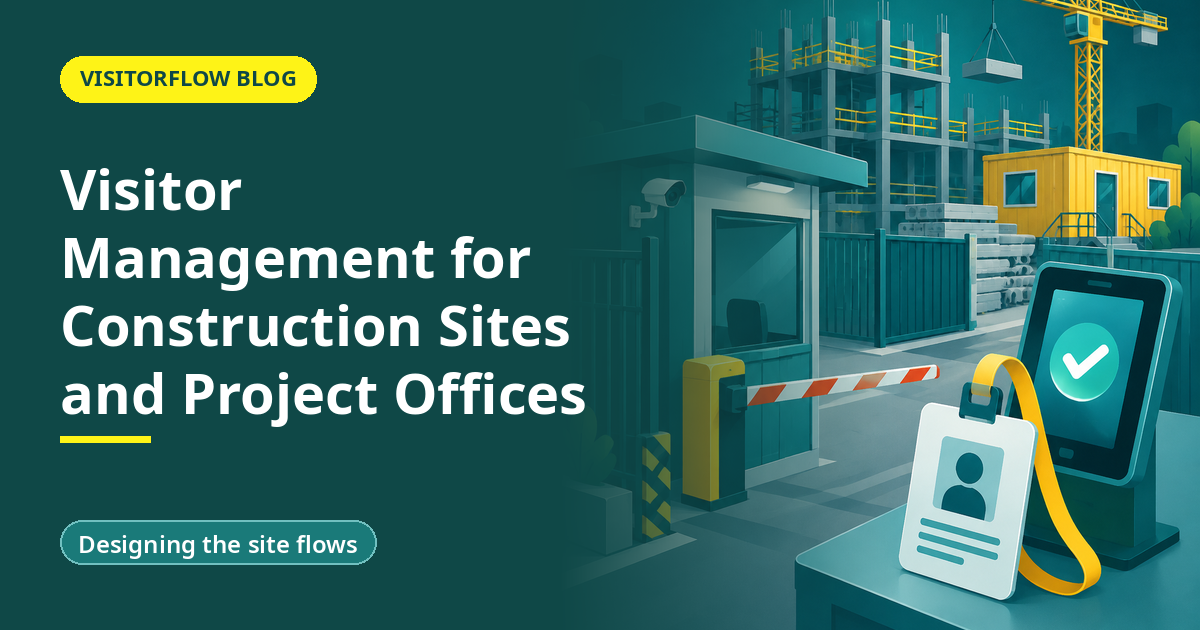
A high-rise project in Thane has 400 workers on site, six subcontractor teams, and a gate manned by two guards per shift. On a Monday, a labour inspector arrives unannounced and asks three questions: who is on site right now, which contractor does each person belong to, and can you show induction records for everyone inside. The site office produces a contractor-wise muster roll that is updated at 9 AM, a visitor book with this week's entries, and a plastic folder of induction certificates. The inspector's report notes that the site cannot account for everyone present, and the principal contractor's safety rating takes the hit.
Construction sites are the hardest visitor environment in this series: a shifting population across dozens of contractors, an unfenced-looking perimeter that changes weekly, and safety obligations that apply to every human inside the hoarding, not just employees. This guide covers what visitor and entry management looks like on a live site. It pairs with our guide to managing visitors, contractors and temp workers in one system and our explainer on what a gate pass is and how it works.
On this page
Everyone inside the hoarding is your responsibility
The legal and practical fact that shapes everything: the principal contractor answers for every person on site, employee or not. The site population on a typical day spans at least six groups, each with a different entry logic. Contractor workers: enrolled by their subcontractor, inducted by the safety team, counted daily. Staff and engineers: the principal's own people. Visitors: client walkthroughs, architect inspections, vendor meetings; hosted and escorted. Inspectors: labour, fire, municipal; unannounced by design. Deliveries: drivers and cleaners who enter briefly but enter. And the informal category: former workers, material suppliers' helpers, curious neighbours; the group the gate exists to stop.
A muster roll covers group one, a visitor book covers group three, and nobody covers the rest. The inspector's question, "who is on site right now", is unanswerable from either, which is why it is the first question inspectors ask.
Key idea: On a construction site the headcount question is a safety question, not an HR question; the day you cannot answer it in one minute is the day the alarm finds out for you.
Muster roll vs visitor register vs a site entry system
Most sites run the muster roll for workers and a register for everyone else. Larger projects add access cards for staff. The comparison shows where each lands on the inspector's three questions.
| The question | Muster plus register | Access cards for staff | VisitorFlow site entry |
|---|---|---|---|
| Who is on site right now? | 9 AM count, stale by 10 | Staff only | Live count across all categories |
| Which contractor do they belong to? | In the roll, not on the visitor | Card says staff, nothing else | Every entry tagged by contractor or sponsor |
| Induction records for everyone inside | Certificates in a folder, matching by hand | Not the card system's job | Induction status on the entry screen, no induction no entry |
| Evacuation accounting | Paper lists in the rain | Staff counted, workers guessed | Live roll call on the safety officer's phone |
Answer the inspector in one minute
VisitorFlow runs site entry across workers, visitors and deliveries with induction checks and a live roll call, on the phones your gate already has.
Explore Visitor ManagementDesigning the site flows
Flow 01
Contractor workers: enrol once, scan daily
The subcontractor enrols each worker with ID and photo; the safety team marks induction status. Daily entry is a QR or ID scan in seconds, and an uninducted worker flags red at the gate instead of being discovered on the scaffold.
Flow 02
Visitors: sponsored, briefed, escorted
Client walkthroughs and architect inspections are pre-registered by their host, get the two-minute safety briefing on the check-in screen, and leave with a record showing host, zones and duration. The client's own auditor will ask for exactly this later.
Flow 03
Inspectors: fast in, fully recorded
Unannounced inspectors get a priority flow: identity captured, escort assigned, purpose logged, and the record shows the site cooperated cleanly. The visit that starts well tends to stay well.
Flow 04
Deliveries: in and out against a material pass
Delivery drivers enter against the material gate pass for their consignment, so people and material share one boundary record. The same steel that gets a gate pass gets a driver whose presence is accounted for.
Inductions, inspections and evacuations
Three records do the heavy lifting for a site's safety rating. Induction coverage: the share of today's entrants with a valid induction, by contractor; when it dips below 100%, the gate already knows whose workers to hold. Inspection readiness: the ability to produce the population and their categories during the inspector's tea, not after their departure. And evacuation accounting: a live roll call by assembly point that marks people safe as they are counted, so the fire tender gets a number, not an estimate.
The practical objection is connectivity and hardware. Site entry systems that depend on fixed kiosks and perfect Wi-Fi die on real sites; the ones that work run on the guards' and supervisors' phones, tolerate patchy signal, and sync when the network returns. Evaluate for that first; the feature list comes second.
Reader Q&A
Our subcontractors rotate workers weekly. Is enrolment practical?
Yes, if enrolment is the subcontractor's job, not yours. Give each contractor a simple enrolment screen; their supervisor enrols a new worker with ID and photo in two minutes before the first shift. Sites that centralise enrolment in the site office fail; sites that distribute it to contractors scale.
What stops workers sharing QRs or badges?
The photo. The gate screen shows the enrolled face next to the person scanning, and a guard glances at it in a second. Sharing collapses because the badge stops being transferable; it is a face, not a token.
Does this work on a site with no reliable internet?
Choose a system that caches at the gate and syncs when connectivity returns; the roll call and entry decisions must work offline. Cloud-only systems with no offline mode belong in offices, not on sites.
How does this interact with labour licence headcounts?
Helpfully. Contractor-wise live counts make licence limits visible daily instead of at renewal time, and the historical record supports your filings. The inspector's question and the licence question are the same data.
Can the client's audit team get reports directly?
A scoped export per audit is the clean pattern: population history, induction coverage, evacuation drills. Clients increasingly write this into contractor safety annexes, and the export answers it without giving away other contractors' data.
Is this overkill for a small project with 50 workers?
The inspector's three questions do not scale down with headcount, and neither does the evacuation problem. A 50-worker site runs the same flows with one gate phone; the cost is a fraction of one penalty or one lost insurance argument.
Bottom line
This week, at 2 PM on any working day, ask your site office for the current headcount by category and contractor, and time the answer. If it involves a muster roll, a register and a phone call, the inspector's first question already beats you.
This quarter, put workers on enrol-once-scan-daily, visitors on sponsored check-in with briefings, and deliveries on material passes. The metric to watch is induction coverage of today's entrants; hold it at 100% and the safety rating, the insurance file and the evacuation drill all improve together.
Every person on site, accounted for
VisitorFlow runs worker entry, visitor management, material gate passes and evacuation roll calls on one cloud platform that works on real sites.
Explore Visitor Management See Material Gate Pass Software Book a Free Demo
Aadeshwar Modi is a marketing technical content writer who loves writing on technology and AI topics.
- From Register Book to Software: Digitizing the Gate Pass
- Inter-Branch Transfer Gate Pass: Keep Stock True Across Units
- Material Inward Gate Pass: Link the Gate with the GRN
- E-Way Bill vs Gate Pass: What Each Document Does
- Gate Pass System for Engineering and Fabrication Workshops
- Gate Pass Software for Pharma and Chemical Plants
- Office Facility Maintenance Checklist: Daily, Weekly, Monthly
- Breakdown Maintenance Log: Record, Analyze, Reduce
- Maintenance KPIs and Dashboards: What to Review Weekly
- AMC Management Software: Contracts, Renewals and Vendor SLAs