Visitor Management for Textile and Garment Factories: Buyer Visits and Social Audits
Published on 10/21/2026 • Updated on 10/22/2026
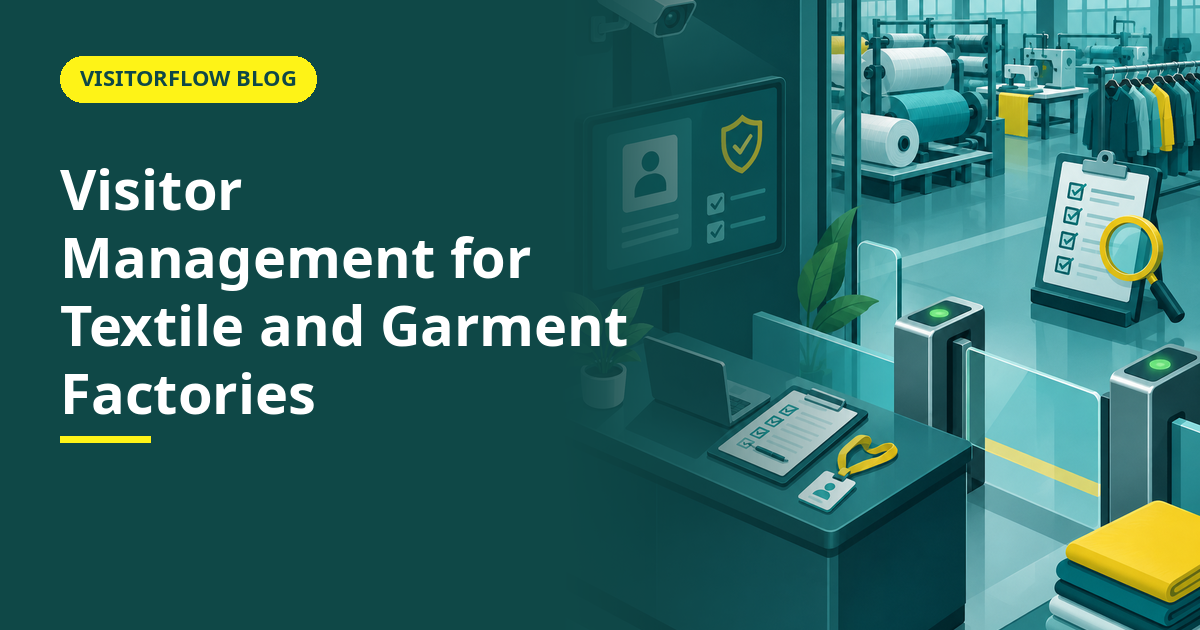
An export garment factory in Gurugram hosts a European brand's social compliance auditor on a Tuesday. The audit opens with a request that surprises no one who has been audited before: the visitor register for the last twelve months, the list of everyone who accessed the production floor, and the factory's process for approving both. The compliance team produces the register; the auditor samples three dates and finds a buyer's QC inspector logged twice on one date, a technician whose entries stop mid-year without explanation, and an afternoon where fifteen "visitors" entered with no host named. The finding goes into the report under access control, and the brand's remediation clock starts.
Garment and textile factories live under a visitor microscope no other industry matches: buyer audits, social compliance frameworks, and brand codes of conduct all read the visitor register as evidence of who really runs the floor. This guide covers visitor management for export units: the audit lens, the categories, and what a defensible record looks like. It builds on our overview of visitor management systems for factories and our piece on how digital visitor management builds compliance culture.
On this page
The buyer audit lens on your gate
Social compliance auditors (amfori BSCI, SMETA, brand-specific codes) treat the visitor register as a truth-telling document: it shows who actually enters the factory, which is how undeclared subcontractors, unauthorised homework coordinators and unauthorised production get discovered. A register with gaps, duplicates and host-less entries reads as a factory that does not control its floor, and in the audit logic, a floor you do not control is a floor that might be subcontracting.
The factory's own interest runs the same way. The gate population spans buyer QC inspectors, machinery technicians, buying-house merchandisers, job applicants, transporters, and government inspectors; each needs a different flow, and the register that lumps them is the register that fails sampling. Security and audit-readiness are the same system wearing two badges.
Key idea: To a buyer's auditor, your visitor register is not a courtesy log; it is the map of everyone who touched production, and they read it looking for the names you did not declare.
Register vs badge book vs a VMS
Most units run a register; organised ones add a numbered badge book so badges reconcile at day's end. The comparison shows where each lands under audit sampling.
| Audit sample question | Paper register | Register plus badge book | VisitorFlow (VMS) |
|---|---|---|---|
| Every entry has a host and purpose | Blank columns under pressure | Badge helps exits, not hosts | Mandatory fields; no host, no entry |
| No duplicate or ghost entries | Found by the auditor, not you | Still handwritten | One record per visit, searchable and clean |
| Production-floor access list, any date | Hours of register reading | Two books to cross-read | Zone filter, date range, export in minutes |
| Visitor identity actually verified | Self-written, unchecked | Badge number, not identity | OTP and ID capture with photo |
A register your auditor samples and finds clean
VisitorFlow records every visit with host, purpose, identity and zones, and exports the access list your buyer asks for in minutes.
Explore Visitor ManagementThe export unit visitor flow
Flow 01
Buyer visitors: hosted from invitation to exit
QC inspectors and merchandisers are pre-registered by their merchandising host, check in with OTP and photo, and get a badge naming their host and zones. The audit sample of any buyer visit shows a complete, professional record, which is also just good account management.
Flow 02
Technicians and vendors: category, zones and history
The sewing machine mechanic and the boiler AMC crew are contractor categories with zones and per-person history. When the auditor asks who serviced the boiler room in March, the answer is a filter, not a folder.
Flow 03
Government inspectors: recorded and escorted
Labour, fire and factory inspectors get a priority flow with identity capture and an assigned escort. Their presence on the record, handled well, is compliance evidence in itself.
Flow 04
Job applicants: to HR, not the floor
Applicants check in to HR zones only. The flow keeps the hiring queue out of the production-floor access list, which is exactly the list the auditor samples.
What social audits actually sample
The sampling pattern is consistent across frameworks: a few dates chosen at the audit table, cross-referenced against production records, wage records and the visitor register. The auditor is looking for three things: names on the floor that appear in no declared list, visit patterns that suggest undeclared subcontracting, and register hygiene (duplicates, gaps, host-less entries) that suggests the register is decorative. A digital register passes the hygiene test by construction and makes the cross-reference answerable in minutes.
The same records serve the brand relationship between audits. When a buyer's compliance team sends a data request, the factory that answers in an hour with clean exports is the factory that gets read as low-risk, and low-risk factories keep orders when portfolios shrink.
Reader Q&A
Will a digital register really change audit outcomes?
It removes the register-hygiene findings entirely and shrinks the sampling exercise from hours to minutes, which changes the audit's tone. It cannot fix a real subcontracting problem; it makes sure you are not punished for one you do not have.
Our buyers' QC inspectors visit weekly. Is OTP check-in overkill?
Repeat visitors check in by scanning their invite; OTP is the identity anchor on first enrolment, not a daily ritual. The weekly inspector's check-in is faster than the register, and the record is audit-grade every time.
How does this handle our job-work tailors and outsourcing units?
Declare them and record them. Job-work coordinators get their own category with zones and history; declared, recorded outsourcing is defensible. The audit problem is the coordinator who is in no register at all.
Can reports be shaped for a specific brand's code of conduct?
Yes: date range, category and zone filters cover the standard asks, and exports land in spreadsheets their compliance team can cross-read against production data directly.
What about the DPDP angle on worker-adjacent visitor data?
Visitor records carry phone numbers and ID details; the system needs access control, retention rules and purge schedules. A digital register with those controls is far safer than the open book at the gate that everyone photographs.
Does it cover worker entry too, or only visitors?
Worker attendance is a separate system, but the same platform handles contractor and temp entry, so the floor-access list the auditor wants includes everyone, not just badge-holding staff. That completeness is the point.
Bottom line
This week, sample your own register the way an auditor would: three dates, cross-read against production, and count the entries without hosts, the duplicates, and the unexplained visitors. The count is your next report's finding, found early.
This quarter, move to hosted digital check-in with zones and verified identity, and rehearse the export your buyer asks for. The metric to watch is register-hygiene findings per audit; at zero, your gate stops being a compliance liability and starts being evidence of a well-run floor.
Pass the sample before it is drawn
VisitorFlow runs visitor, contractor and evacuation workflows on one cloud platform, with audit-grade records export garment units rely on.
Explore Visitor Management See Material Gate Pass Software Book a Free Demo
Ed Jhonson is a Sourcing & Marketing Expert who writes content related to Technology and Engineering topics.
- From Register Book to Software: Digitizing the Gate Pass
- Inter-Branch Transfer Gate Pass: Keep Stock True Across Units
- Material Inward Gate Pass: Link the Gate with the GRN
- E-Way Bill vs Gate Pass: What Each Document Does
- Gate Pass System for Engineering and Fabrication Workshops
- Gate Pass Software for Pharma and Chemical Plants
- Office Facility Maintenance Checklist: Daily, Weekly, Monthly
- Breakdown Maintenance Log: Record, Analyze, Reduce
- Maintenance KPIs and Dashboards: What to Review Weekly
- AMC Management Software: Contracts, Renewals and Vendor SLAs