Near Miss vs Incident vs Accident
Published on 10/18/2026 • Updated on 10/23/2026
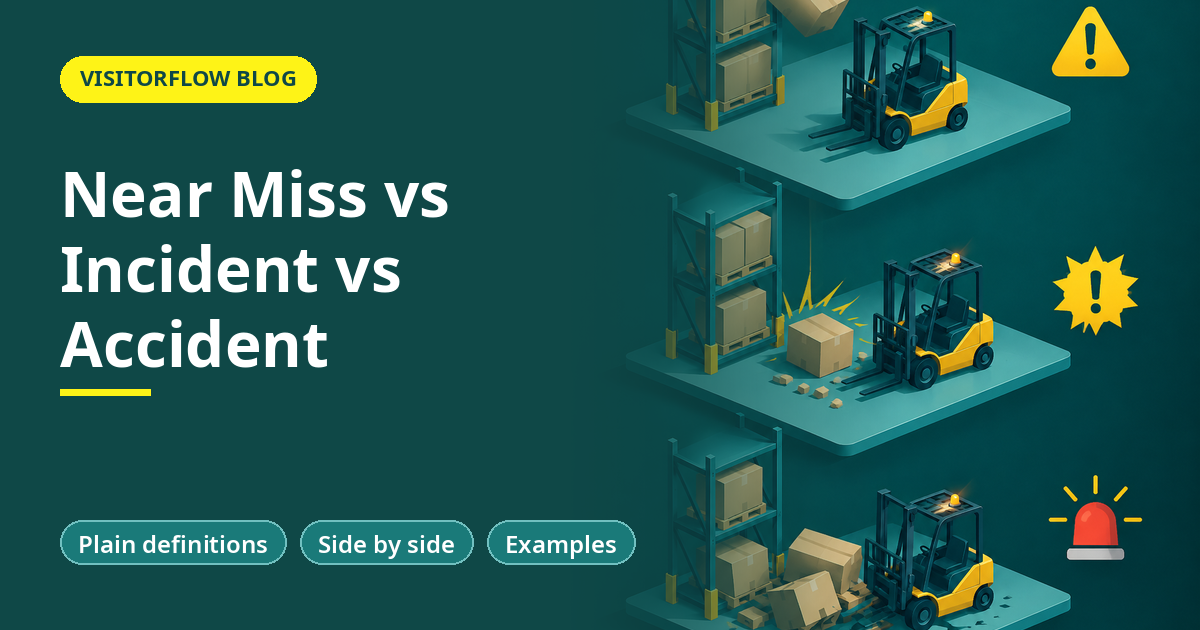
A supervisor tells the safety officer there was an accident in the store. The officer asks if anyone was hurt. The supervisor says no, a pallet fell but nobody was there. Is that an accident, an incident or a near miss? The answer decides how it is recorded, how fast it is investigated and whether it appears in the safety numbers.
The three terms are often used loosely. This guide gives plain definitions, a comparison table, examples, a method for classifying any event and the reasons to use the terms consistently. Definitions differ a little between organisations and standards, so agree one set at your site and write it down.
On this page
Plain definitions
| Term | Meaning in plain words |
|---|---|
| Near miss | An unplanned event with no injury or damage, but it could have caused one |
| Incident | Any unplanned event that caused or could have caused harm or damage. A broad term |
| Accident | An unplanned event that resulted in injury, illness or damage |
Many organisations treat incident as the umbrella. Near misses and accidents are both kinds of incident. Others use incident for events with minor effects and accident for serious ones. Check the definitions used in your own safety policy and any standard your site follows.
Key idea: Pick one set of definitions, write it on one page and use it everywhere. Consistency matters more than which words you choose.
Side by side
| Point | Near miss | Incident | Accident |
|---|---|---|---|
| Harm happened | No | Maybe | Yes |
| Could have caused harm | Yes | Yes | Yes |
| Example | Pallet falls beside a worker | Pallet falls, damages stock | Pallet falls, worker injured |
| Reported | Yes, as a warning | Yes | Yes, with a full investigation |
| Typical response | Fix the hazard | Review and fix | Investigate and fix; notify authority if required |
Examples
| Event | Class |
|---|---|
| Worker slips on oil but catches the rail | Near miss |
| Forklift scrapes a rack, no one nearby | Incident (damage) |
| Worker cuts a hand on a guard edge, needs stitches | Accident |
| Visitor enters a restricted area, guard stops him | Near miss (security) |
| Small fire put out with an extinguisher, no one hurt | Incident |
| Fall from a ladder, fracture | Accident |
Where the line falls depends on your policy. What matters is that two people looking at the same event reach the same label.
How to classify an event
Step 01
Was anyone hurt or anything damaged?
If yes, record the injury or damage. This is an accident or an incident with harm.
Step 02
If not, could it have caused harm?
If yes, it is a near miss.
Step 03
Rate the potential
High, medium or low by what could have happened.
Step 04
Assign the response
Match the investigation depth to the rating and the outcome.
A near miss with high potential deserves a response close to that of an accident.
Why the words matter
- Reports sort correctly, and counts mean something.
- Investigations match the seriousness of the event.
- Legal reporting duties are not missed for events that qualify.
- Near misses are not dismissed as nothing happened.
- Trends can be compared between months and sites.
Ask your safety officer which events in your industry and state must be reported to an authority, and in what time. Do not rely on the label alone to decide that.
Classify and track every event
VisitorFlow Incident Management records near misses, incidents and accidents with the same form and a clear status.
See Incident Management SoftwareWhat to count
Many sites track injury rates, which count accidents. Fewer track near misses, which count warnings. Count both, because they tell different stories. A low injury rate with no near miss reports can mean a safe site, or it can mean people do not report. A healthy site often shows many near misses and few accidents.
Our guides on near miss reporting and on the incident report format cover the system and the form.
Grey areas
Some events do not fit neatly. A worker feels a twinge in the back after lifting and goes home early. Is it an accident? A worker is exposed to fumes for a few minutes and has a headache later. Is it an incident? When in doubt, record it, classify it provisionally and review it with the safety officer. A late-appearing injury can change the label. Write the original time and the date of the update on the report so that the history is clear.
Events involving contractors and visitors fall under the same definitions. A visitor who trips on a step is an accident at your site, whoever employs him, and the report should say so.
Legal reporting and records
Different laws and standards require certain events to be reported to authorities and kept on record. The rules depend on the industry, the size of the site and the state. Ask your safety officer or adviser for the list that applies to you, and add it to your definitions page so supervisors know which events trigger a call. Keep the records for the period the law or your policy requires, and store them where the safety officer can find them quickly.
Teaching the terms to supervisors
A short exercise works well. Give supervisors ten short event descriptions and ask them to classify each. Compare answers and discuss the differences. In an hour you will see where the definitions are unclear and which words people use differently. Repeat the exercise for new supervisors, and keep the descriptions as a standing training set.
Put the one-page definitions on the safety notice board and on the back of the report form, so that nobody has to look for them at the moment they need them.
A worked example
Event: 10:30, a bag of cement slips from a stack.
Case A: nobody near. No damage. Near miss. Case B: bag bursts, floor stock lost. Incident. Case C: bag hits a worker, bruised ribs. Accident.
Same cause in all three: stack too high, no stop. One fix: stack limit and a stop board.
The example is made up. It shows that the cause is the same and only luck differs. The fix is the same too, so treat all three as chances to fix the hazard.
Common mistakes
Calling it nothing
No harm still means a hazard.
Mixed terms
Two teams using two meanings give two sets of numbers.
Judge by potential
Rate what could have happened.
Another mistake is hiding accidents as incidents to keep the numbers low. It is dishonest and it defeats the purpose of counting.
A third is spending all the effort on accidents. The near misses have the same causes and cost less to fix.
A fourth is letting the label decide the effort. A near miss with a high potential can be more important than a minor accident, so give each event the response its potential deserves.
A two-week alignment
Make your terms consistent.
Step 01
Days 1 to 3: define
Write the one-page definitions with the safety officer.
Step 02
Days 4 to 8: apply
Reclassify last month's reports using them.
Step 03
Days 9 to 14: brief
Share with supervisors and update the form.
Review the definitions each year with the safety committee, and note any change in the law or in your industry standard. After the review, update the form, retrain the supervisors and tell the teams what changed and why. A definition page that is a year out of date is as bad as none, because it creates a false sense that the matter is settled while people quietly go back to their own meanings.
Five-minute self-check
Check your classification against these points.
Answer yes or no
- ☐ Are the three terms defined in writing?
- ☐ Do all supervisors use them the same way?
- ☐ Are near misses rated by potential?
- ☐ Do you know your legal reporting duties?
- ☐ Do you count near misses and accidents?
Two or more no answers mean this is worth fixing before anything else on your list.
Reader Q&A
What is the difference between a near miss and an accident?
A near miss caused no injury or damage but could have. An accident caused injury, illness or damage.
Is an incident the same as an accident?
Often incident is the broader term and accident is one kind. Some organisations use them differently, so write your definitions down.
Which events must be reported to authorities?
It depends on your industry, state and the law. Ask your safety officer or adviser, since the label alone does not decide it.
Should near misses be investigated?
Yes, in proportion to their potential. A high-potential near miss deserves a thorough review.
Why is consistency important?
So reports are sorted the same way, counts mean something and the response matches the event.
Where do I start?
Write a one-page definition set, share it with supervisors and use it on every report form.
Bottom line
Near miss, incident and accident are related and often confused. Use clear definitions, classify by what happened and by what could have, and match the response.
Write your one-page set of definitions this week, share it with every supervisor and print it on the back of the report form so it is always at hand.
One system for every kind of event
VisitorFlow runs visitor, material gate pass, courier, maintenance and incident workflows on one cloud platform.
See Incident Management Software See Material Gate Pass Software Book a Free Demo
Aadeshwar Modi is a marketing technical content writer who loves writing on technology and AI topics.
- From Register Book to Software: Digitizing the Gate Pass
- Inter-Branch Transfer Gate Pass: Keep Stock True Across Units
- Material Inward Gate Pass: Link the Gate with the GRN
- E-Way Bill vs Gate Pass: What Each Document Does
- Gate Pass System for Engineering and Fabrication Workshops
- Gate Pass Software for Pharma and Chemical Plants
- Office Facility Maintenance Checklist: Daily, Weekly, Monthly
- Breakdown Maintenance Log: Record, Analyze, Reduce
- Maintenance KPIs and Dashboards: What to Review Weekly
- AMC Management Software: Contracts, Renewals and Vendor SLAs