How to Prevent Tailgating in Your Office
Published on 10/21/2026 • Updated on 10/23/2026
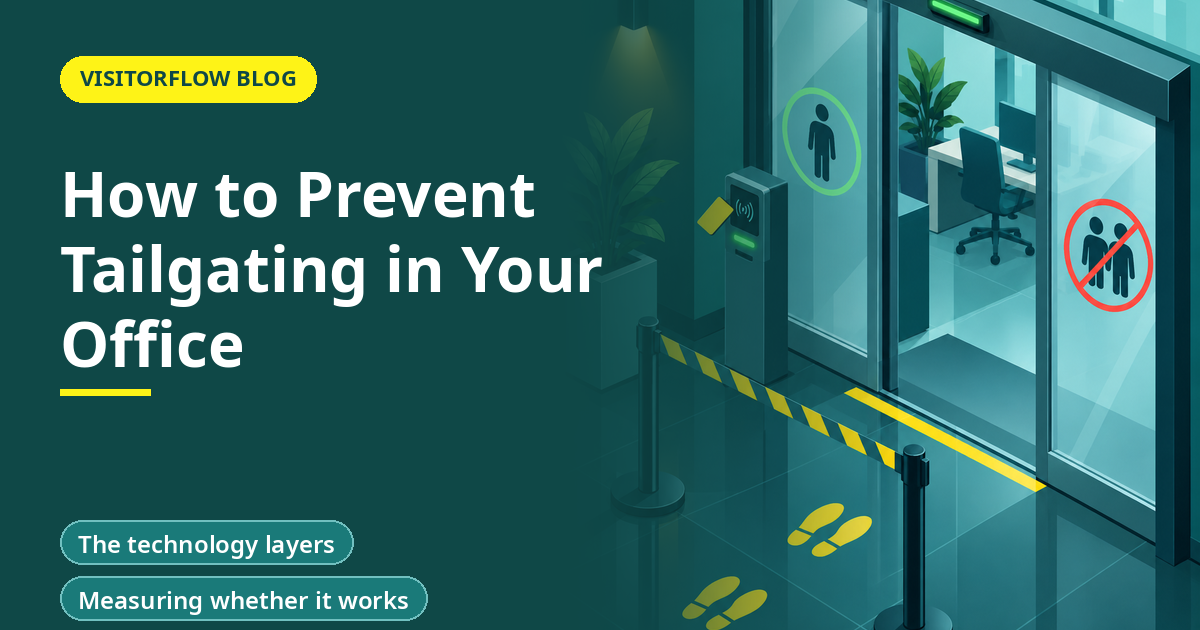
A building's CCTV, reviewed after a laptop theft, shows the thief entering at 10:42 AM. He does not force a door, clone a card, or do anything cinematic. He simply walks in behind an employee, who holds the door with the automatic courtesy everyone extends to a person carrying a pizza box. Twenty seconds of footage, one polite gesture, and the building's entire access control investment is defeated by manners. The security head's report contains a sentence that should be printed above every turnstile in the country: the system worked exactly as designed; the design assumed people would be rude to strangers.
Tailgating (and its cousin, piggybacking, where the insider knowingly lets someone in) is the most common physical breach precisely because it exploits courtesy rather than hardware. This guide covers where it actually happens, the layered controls that work (policy, culture, technology), and how to measure whether any of it is working. It pairs with our guide on preventing visitor buddy punching and our face recognition analysis.
On this page
Where tailgating actually happens
Not at the main gate, which everyone watches. The breach points are the polite ones. The lobby door at lunch hour, when a queue of employees badges in and each holds the door for the next. The smoking-zone door, which opens from outside with a badge and stays open while three people file back in. The fire-exit stairwell door someone wedges for a delivery. The service corridor the housekeeping vendor uses, whose latch has been "getting fixed" for a quarter. And the visitor route itself: a checked-in visitor who simply keeps walking past reception into the floor, having been verified but never escorted.
The pattern worth internalising: tailgating follows the path of least social friction, not least physical resistance. A determined intruder case-studies your building the way your own team never does: which door opens most often, who holds it, and what prop (pizza box, ladder, ID card worn backwards on a lanyard) makes holding it feel natural. Your counter-strategy starts from the same observation. Walk your own perimeter at 1 PM on a weekday and watch the doors for ten minutes each; the building will show you its breach points without any technology at all.
The policy and culture layer
Technology without culture produces a brief, expensive improvement and then regression, because the courtesy instinct does not retire. The culture change has three parts, and each has a failure mode worth naming.
Rule 01
Make not-holding-the-door the norm, not the insult
The policy ("one badge, one entry") fails when employees experience it as being rude to colleagues and guests. Reframe it in onboarding and refreshers: holding a secure door open is not courtesy, it is lending your access to a stranger, and declining is professionalism. Give people the words: "sorry, policy, you'll need to badge" said cheerfully is a complete sentence. Failure mode: policy announced once by email, dead in a month.
Rule 02
Give the challenged person a graceful path
People tailgate because the alternative is friction: a forgotten badge means a trip to reception and a queue. If the forgotten-badge path is a thirty-second desk check with a photo and a one-day pass, compliance is cheap. If it is a twenty-minute ordeal, the organisation trains itself to hold doors. Failure mode: strict door, impossible exception process, universal workaround.
Rule 03
Make leadership visibly comply
The CEO who waves their guest through without a pass teaches the whole building that the rule is for junior staff. The CEO who walks their guest to reception and waits for the badge teaches the opposite, and people notice. Every security culture survey eventually finds the same variable: whether the top floor follows the ground-floor rules. Failure mode: an unwritten VIP exemption that everyone quietly extends.
The technology layers
Layer 01
Visitor verification and escort workflow
The cheapest layer and the one this platform owns: verified check-in with host approval, a badge that shows host and zone, and a host-notification loop that makes the escort real. The visitor who "keeps walking past reception" fails here, because the host is waiting for them and the floor knows an unescorted badge-less person is an anomaly worth a question.
Layer 02
Anti-passback and door discipline
Access control settings that refuse a badge used twice without an exit (anti-passback), door-held-open alarms tuned to seconds not minutes, and the physical un-wedging of the stairwell door, enforced weekly until it stays enforced. None of this is glamorous; all of it is where the pizza-box walk actually gets blocked.
Layer 03
Detection: sensors, analytics, guards
Turnstiles with optical tailgate detection for high-security lobbies, video analytics that flag two-bodies-one-badge events for review, and the oldest sensor: a guard whose job description includes challenging, not just greeting. Detection is the audit layer; it tells you your rate, catches the repeat offender, and proves the first two layers work.
Measuring whether it works
You cannot manage "it feels safer". Three practical measures. Door-held-open alarm counts per door per week, trended; a rising alarm count at one door is a culture problem with an address. Periodic challenge tests: an authorised tester attempts a tailgate monthly and records whether anyone intervenes; the intervention rate is your true culture metric, and publishing it (anonymised) improves it faster than any memo. And unescorted-visitor sightings logged by floor staff, which should trend to zero once the escort workflow is real.
Review the three monthly with security and facilities, and expect the first quarter to look worse than the baseline, because measurement reveals what courtesy was hiding. That is progress, not regression. The buildings that catch tailgaters are not the ones with the most incidents; they are the ones whose incidents are finally visible.
Verified visitors, escorted floors
VisitorFlow's host-approval and badge workflows close the visitor-route tailgate, and its reports show the rest.
Explore Visitor ManagementA thirty-day rollout that sticks
Week one is observation only: the door watches, the alarm-count baseline, and a list of the three worst doors. Announcing nothing yet is deliberate; a policy announced before the baseline invites everyone to claim the problem is exaggerated. Week two fixes the physics: un-wedge the stairwell, tune the held-open alarms, repair the service-corridor latch that has been "getting fixed" since last quarter. Week three is the culture launch: onboarding script, the standard phrase, the forgotten-badge fast path, and a visible moment of leadership compliance at the busiest door at the busiest hour.
Week four is the first challenge test and the first honest numbers. Publish the intervention rate and the alarm trend to the floor managers, not as blame but as the scoreboard it is. Buildings that run this cycle report the same arc: alarm counts spike in week two as measurement turns on, fall through the quarter as the culture layer bites, and settle at a low steady state that the challenge test then keeps honest. The pizza-box walk does not survive a building that knows its own doors.
Reader Q&A
Do we need turnstiles to stop tailgating?
Only at genuinely high-security lobbies. For most offices, culture plus door discipline plus a working visitor workflow closes most of the exposure at a tenth of the cost. Turnstiles with optical detection are the answer when the threat model justifies them (data centers, R&D, cash handling), not as a substitute for the cheap layers.
How do we stop employees holding the door without making enemies?
Change the script, not the people. Onboarding that reframes door-holding as lending your access, a cheerful standard phrase, a forgotten-badge path that takes thirty seconds, and visible leadership compliance. The goal is that refusing feels as normal as the courtesy it replaces, and that takes a quarter of reinforcement, not a memo.
What is the difference between tailgating and piggybacking?
Tailgating is covert; the insider does not know. Piggybacking is consensual; the insider knowingly lets someone through, from courtesy or collusion. The defences differ: culture and detection for the first, verification and anti-passback for the second, and both start with knowing your doors.
Our fire doors must open freely. Are they a lost cause?
Fire doors must open from inside for egress; they do not have to admit people from outside, and they do not have to stay silent. Alarmed, self-closing, never wedged, and camera-covered is compliant and secure. The wedge is the problem, and the wedge is a habit, and habits yield to weekly enforcement.
Can a visitor system help with employee tailgating?
Indirectly but genuinely: the escort-and-badge norm for visitors raises the whole building's anomaly awareness, so an unbadged person on the floor reads as wrong regardless of how they entered. For direct employee-entry control, pair with access control anti-passback and our buddy punching guide.
Where does face recognition fit?
At enrolment-backed lanes where one-face-one-entry can be enforced, and as analytics flagging mismatches between badge events and faces. It is a strong layer three, a poor substitute for layers one and two. Our face recognition guide covers the privacy and cost trade-offs honestly.
Bottom line
This week, do the ten-minute door watch: lobby at lunch, the smoking door, the stairwell. Count the holds. That count is your baseline, and it cost nothing to collect.
This quarter, attack in order: culture script and forgotten-badge path first, door discipline and anti-passback second, detection third. The pizza-box walk works because it is polite; the counter is a building where security is also polite, and just as automatic.
Close the door courtesy opens
VisitorFlow verifies every visitor, notifies every host, and badges every guest, so an unescorted stranger on your floor is instantly visible.
Explore Visitor Management See Material Gate Pass Software Book a Free Demo
Ed Jhonson is a Sourcing & Marketing Expert who writes content related to Technology and Engineering topics.
- From Register Book to Software: Digitizing the Gate Pass
- Inter-Branch Transfer Gate Pass: Keep Stock True Across Units
- Material Inward Gate Pass: Link the Gate with the GRN
- E-Way Bill vs Gate Pass: What Each Document Does
- Gate Pass System for Engineering and Fabrication Workshops
- Gate Pass Software for Pharma and Chemical Plants
- Office Facility Maintenance Checklist: Daily, Weekly, Monthly
- Breakdown Maintenance Log: Record, Analyze, Reduce
- Maintenance KPIs and Dashboards: What to Review Weekly
- AMC Management Software: Contracts, Renewals and Vendor SLAs