Preventive vs Predictive vs Breakdown Maintenance
Published on 10/18/2026 • Updated on 10/23/2026
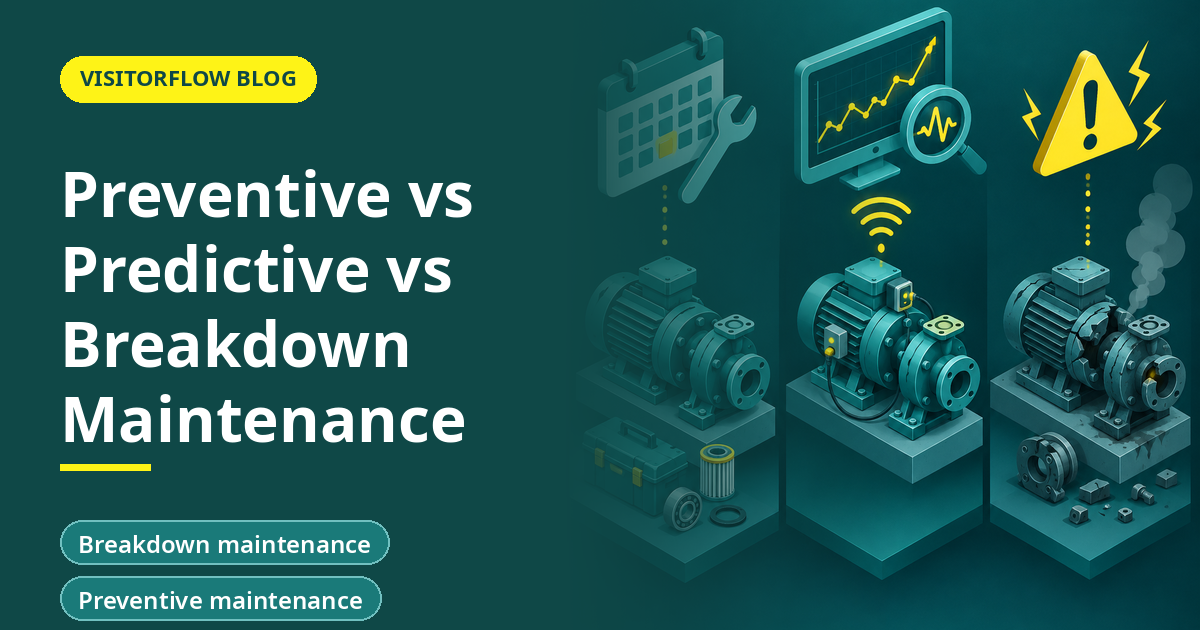
A plant has three kinds of machines. Some are serviced by the calendar. Some are watched with instruments and serviced when the readings change. Some are left alone until they stop. Each approach is right for some machines and wrong for others, and the real skill is knowing which is which.
This guide explains preventive, predictive and breakdown maintenance in plain words, compares them in a table, gives examples from a typical plant, and shows how to choose a strategy for each asset. It uses assumed examples, not published statistics.
On this page
- The three types in one line each
- Breakdown maintenance
- Preventive maintenance
- Predictive maintenance
- Side by side
- Choosing a strategy for each asset
- Thinking about cost the right way
- A simple way to decide
- People and skills for each approach
- A worked example
- How to move from breakdown to planned
- Common mistakes
- A 30-day review
- Five-minute self-check
- Reader Q&A
- Bottom line
The three types in one line each
| Type | In one line | Trigger |
|---|---|---|
| Breakdown (run to failure) | Fix it after it fails | Failure |
| Preventive | Service it on a schedule | Time or usage |
| Predictive (condition-based) | Service it when measurements show wear | Condition reading |
Corrective maintenance is the work done after a fault. Breakdown maintenance is the policy of letting a machine run until it fails, then repairing it. They are close, but the second is a choice, not an accident.
Breakdown maintenance
Breakdown maintenance means no planned work on the asset. You repair or replace it when it stops. It is cheap to start and expensive when applied to the wrong machine.
- Fits: low cost, easy to replace, no safety risk, a spare on the shelf, such as an office fan or a small pump with a standby.
- Does not fit: single points of failure, high repair cost, safety critical equipment.
The hidden cost is not the part. It is the stopped line, the overtime and the rush freight.
Preventive maintenance
Preventive maintenance is work done at fixed intervals, by days or running hours, to reduce the chance of failure. Oil changes, filter replacement, greasing, belt checks and calibration are typical.
- Fits: wear is predictable by time or use, failure is costly and the task is cheap.
- Does not fit: failures are random, or the task itself causes faults, such as opening a healthy gearbox.
Our guide on the preventive maintenance schedule shows how to build the list.
Predictive maintenance
Predictive maintenance, also called condition-based, uses measurement to decide when work is needed. Typical measures are vibration, temperature, oil analysis, current draw and ultrasound. When a reading crosses a limit, the team plans the repair.
- Fits: expensive or critical machines where failure gives warning, such as large motors, gearboxes, compressors and pumps.
- Does not fit: cheap assets where the sensor costs more than the machine, or failure modes that give no warning.
It needs instruments, trained people and a baseline for each machine. Many plants start with a handheld thermometer, a vibration pen or a thermal camera on a monthly round, before buying online sensors.
Side by side
| Point | Breakdown | Preventive | Predictive |
|---|---|---|---|
| Upfront cost | Lowest | Medium | Highest |
| Unplanned stops | Many | Fewer | Fewest |
| Needs data | No | Some | Yes |
| Skill needed | Repair | Planning | Measurement and analysis |
| Risk of over-servicing | None | Yes | Low |
| Best for | Low value assets | Predictable wear | Critical assets with warning signs |
Track all three in one place
VisitorFlow Maintenance keeps breakdowns, scheduled tasks and readings in one asset history.
See Maintenance Helpdesk SoftwareChoosing a strategy for each asset
Step 01
Rank criticality
A, B or C by effect on production and safety.
Step 02
Check failure behaviour
Does it give warning, wear by time or fail at random?
Step 03
Match the strategy
A critical machine with warning signs: predictive. Predictable wear: preventive. Low value and easy to swap: breakdown.
Step 04
Review yearly
Change the strategy when breakdown data shows it is wrong.
A plant almost always uses all three. The mix matters more than the label.
Thinking about cost the right way
The cheapest policy on paper is often the dearest in practice. Compare three costs for each important asset: the cost of the planned work, the cost of a breakdown and the chance of that breakdown. If a bearing costs Rs 2,000 to replace on schedule and a failure costs Rs 2 lakh in lost output, then even a one in ten chance of failure each year makes the schedule pay.
The figures above are an example, not data. Use your own numbers: the hourly value of the line, repair cost, overtime and the delay in restarting. Finance can help you set the hourly value, and it is worth fifteen minutes to agree on one number that you then use everywhere.
A simple way to decide
For each critical asset, ask what happens if it fails, how it usually fails and what warning it gives. If the answer to the third is a clear change in noise, heat or vibration, a condition check can catch it. If the answer is nothing, only a time-based task or a spare can protect you.
This is a light version of reliability-centred maintenance. You do not need a formal study to use the idea. A one hour workshop with the maintenance lead, an operator and a supervisor per critical machine is often enough.
People and skills for each approach
Breakdown work needs quick, skilled repairers. Preventive work needs planners and disciplined technicians who follow the card. Predictive work needs someone who can read the numbers and tell a normal trend from a warning. Do not expect one person to do all three well. Train one or two technicians in condition checks and let them build the rounds, while the rest follow the planned cards.
A worked example
The numbers are invented to show the split, not to set a target.
How to move from breakdown to planned
Do not try to change everything at once. Start with the machines that hurt most. List the last ten breakdowns, count which asset caused each and what it cost in lost hours. The top three assets deserve a preventive task or a condition check first. Our guide to MTTR and MTBF shows how to measure whether the change worked.
Keep the first tasks cheap and visible, and ask the operators to help, since they hear and feel changes first: a weekly walk-round with a checklist, a monthly temperature check with a handheld thermometer, a lubrication route. These cost little and often catch the first signs of trouble.
Common mistakes
Servicing everything
Preventive work on a healthy low value asset wastes time.
Buying sensors first
Prove the need with a handheld check before you buy.
Mix the three
Use each where it fits.
Another mistake is treating predictive as a replacement for preventive. Some wear is best handled by a simple scheduled task.
A third is collecting readings with no limits. A number with no alert level is just a number.
A fourth is keeping the strategy in one person's head. Write the choice for each critical asset in the asset record, so a new supervisor can see the plan and the reason.
A 30-day review
Pick the right strategy for your top assets.
Step 01
Week 1: list
List your last ten breakdowns and the asset behind each.
Step 02
Week 2: rank
Rank assets A, B or C.
Step 03
Weeks 3 and 4: assign
Choose a strategy for each A and B asset and start the first tasks.
Review the results after three months using downtime hours, and share the result with the shift teams, and thank those who found the early warnings.
Five-minute self-check
Check your maintenance mix against these points.
Answer yes or no
- ☐ Are assets ranked by criticality?
- ☐ Do critical assets have a planned strategy?
- ☐ Do you know your top three breakdown causes?
- ☐ Are readings compared with limits?
- ☐ Is the strategy reviewed yearly?
Two or more no answers mean this is worth fixing before anything else on your list.
Reader Q&A
What is the difference between preventive and predictive maintenance?
Preventive is done on a fixed schedule by time or usage. Predictive is done when measurements show the machine needs it.
What is breakdown maintenance?
A policy of repairing equipment only after it fails. It suits low value assets with easy replacement.
Which maintenance type is best?
None for everything. Critical machines with warning signs suit predictive, predictable wear suits preventive and cheap assets can run to failure.
Is predictive maintenance expensive?
It costs more upfront because of instruments and training. Many plants start with handheld tools and a monthly round.
What is corrective maintenance?
Work done to repair a fault after it has occurred. Breakdown maintenance is the policy of relying on it.
How do I know which assets need what?
Rank by criticality, study the failure behaviour and match the strategy. Review it each year with breakdown data.
Bottom line
Breakdown, preventive and predictive maintenance are tools, not rivals. Use each for the assets where it pays.
Rank your assets, study how they fail and start with the machines that cost you most. Review the choice every year.
See the whole maintenance picture
VisitorFlow runs visitor, material gate pass, courier, maintenance and incident workflows on one cloud platform.
See Maintenance Helpdesk Software See Material Gate Pass Software Book a Free Demo
Aadeshwar Modi is a marketing technical content writer who loves writing on technology and AI topics.
- From Register Book to Software: Digitizing the Gate Pass
- Inter-Branch Transfer Gate Pass: Keep Stock True Across Units
- Material Inward Gate Pass: Link the Gate with the GRN
- E-Way Bill vs Gate Pass: What Each Document Does
- Gate Pass System for Engineering and Fabrication Workshops
- Gate Pass Software for Pharma and Chemical Plants
- Office Facility Maintenance Checklist: Daily, Weekly, Monthly
- Breakdown Maintenance Log: Record, Analyze, Reduce
- Maintenance KPIs and Dashboards: What to Review Weekly
- AMC Management Software: Contracts, Renewals and Vendor SLAs