Vendor and Supplier Visitor Management at the Factory Gate
Published on 10/21/2026 • Updated on 10/23/2026
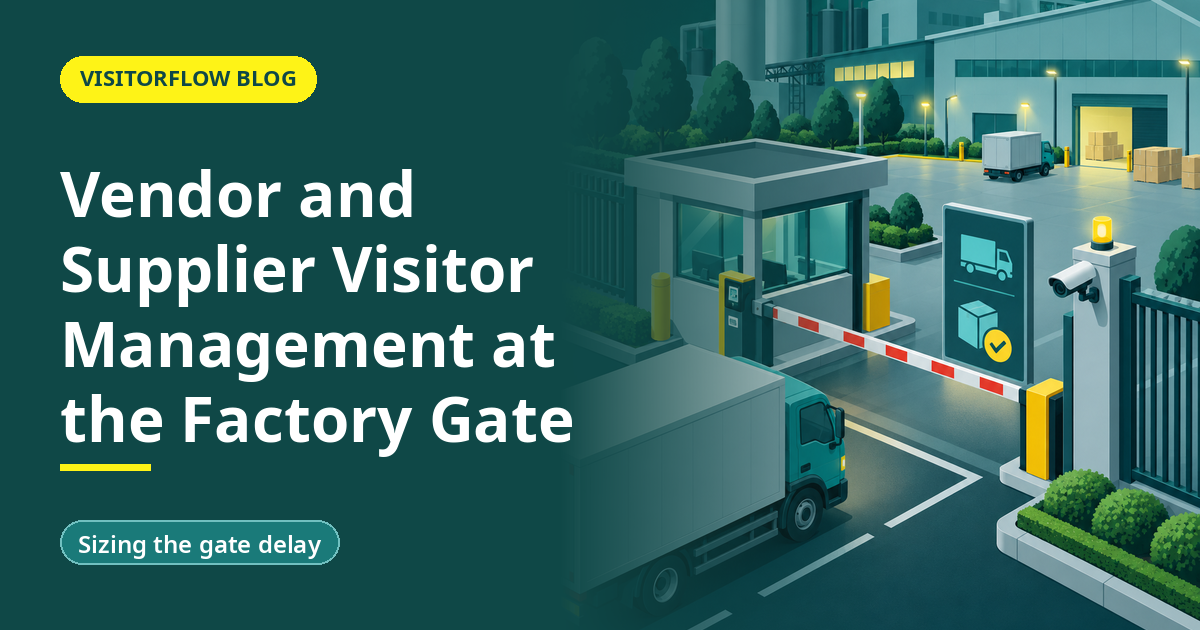
At 7:40 on a Monday, a pump supplier's two technicians arrive at a chemicals plant for a seal replacement job raised last Thursday. The gate has no record of the job because the purchase order sits in an inbox, the maintenance engineer who raised it is on the morning shift handover call, and the contractors' safety induction status lives in a file in the admin office. The technicians wait ninety minutes, the job starts late, and the seal change that should have finished before the day shift pushes into it instead.
This guide covers vendor and supplier visitor management at the factory gate: how supplier visits differ from ordinary guests, what the gate needs to know before the truck arrives, and how to connect the visit to the purchase or work order that authorised it. For the visitor side of the picture, our guide to visitor pre-registration covers invite flows; for the material side, our guide to the digital gate pass system covers what leaves with the truck.
On this page
Why supplier visits are a different class of visitor
Vendor visitor management is the control of supplier, contractor and service-provider entry against a commercial document: a purchase order, a work order, an AMC schedule or a delivery note. An ordinary guest visits a person; a supplier visit executes a transaction. That difference changes what the gate must check and what the record must prove.
Four properties separate supplier visits from guest visits:
- They are authorised by a document, not a person's invitation. The PO or work order is the reason for entry, and the gate should be able to see it.
- They bring things in and take things out. People, tools, material and vehicles all need matching entry and exit records, which is where the gate pass side connects.
- They repeat on schedules. AMC crews, calibration teams and milk-run suppliers come weekly or monthly, so re-registering them from scratch each time is pure waste.
- They carry safety and compliance conditions. Inductions, insurance and validity dates gate the work, not just the welcome.
Get these four right and the supplier gate stops being the plant's slowest queue. Get them wrong and every visit re-negotiates its own existence at the window, with the day shift waiting on the other side.
Key idea: A supplier at the gate is a purchase order with legs; if the gate cannot see the order, it is guessing at the welcome mat.
There is also a planning dividend. When supplier visits live in a calendar the plant can see, maintenance stops scheduling three vendors for the same Monday and none for the rest of the week. The gate's expected list doubles as a workload forecast, and the stores team knows which days will need receipt bays clear before the trucks arrive.
Register vs gate phone calls vs order-linked visits
The three ways plants handle supplier entry differ mostly in where the authorisation lives at the moment the truck arrives.
| At the gate | Register plus phone calls | ERP gate screen | VisitorFlow (order-linked visits) |
|---|---|---|---|
| Gate sees today's expected suppliers | No; each arrival is a surprise | PO exists in ERP, but not at the gate | Yes, an expected list per day and gate |
| Authorisation check before entry | Call the engineer, hope they pick up | Guard looks up PO, if trained and fast | Visit is tied to the PO or work order by the raiser |
| Repeat crews (AMC, calibration) | Full registration every visit | PO repeat entry, still manual | Recurring passes with per-day scan-in |
| People and material records agree | Two books that rarely reconcile | Material yes, people no | One visit record links crew, vehicle and material |
Suppliers arrive expected, not announced
VisitorFlow links each supplier visit to its purchase or work order, with recurring passes for AMC crews and one record for people, vehicle and material.
Explore Visitor Management SoftwareSetting up order-linked vendor visits in three steps
Step 01
Make the raiser create the visit
Whoever raises the PO or work order names the visit: company, expected date and window, crew size, vehicle, and what comes in or goes out. The supplier gets a confirmation with the gate instructions, and the gate gets the expected list without a phone call.
Step 02
Set recurring passes for scheduled crews
AMC and calibration crews get a pass valid for the contract period, with a scan at each visit. Induction and insurance validity sit on the pass, so an expired document blocks the entry before the crew parks, not after the job starts.
Step 03
Reconcile people and material at exit
The same visit record closes both sides: the crew scans out, and any material leaving with them carries a gate pass tied to the visit. A supplier who entered with six toolboxes and leaves with four has a question to answer at the window, while the answer is still cheap.
A note on who does the work: none of these steps adds a desk. The raiser names the visit as part of raising the order, the supplier confirms its own crew, and the gate verifies instead of registering. The labour moves from the window to the source, which is where the information always was.
Sizing the gate delay
Supplier waiting time is a real cost: crews bill hours, trucks idle, and jobs slip into production windows. Substitute your own numbers.
63 hours
Crew waiting removed per month in the worked example
4 min
Gate time when the visit is expected and order-linked
1 record
Linking the crew, the vehicle and the material for each visit
Mistakes that keep the gate slow and the record thin
Common mistakes
- Letting purchase raise orders without naming the visit. The order exists, but the gate cannot see it, so the phone call survives.
- Treating all suppliers alike. A milk-run vendor and a one-time crane hire need different pass rules, not the same queue.
- Checking documents after parking. An expired induction discovered at the window costs a reschedule; discovered in advance, it costs an email.
- Counting only entry. Without an exit scan, half the security value and all of the material reconciliation disappear.
What good looks like
- Every supplier visit names its authorising order before the truck leaves the supplier's yard.
- Recurring crews scan in with valid documents, and expiries surface before they block a job.
- The gate's morning view is an expected list, not a blank register.
- Exit reconciles crew, vehicle and material against the same visit that let them in.
Reader Q&A
Does this replace the gate pass for material?
No, it complements it. The vendor visit covers the people and the vehicle; the material gate pass covers what leaves the premises. The two records link, so the exit check sees both sides of the same transaction.
What about unscheduled supplier arrivals?
The gate raises a visit on the spot and the responsible buyer or engineer approves from their phone. The arrival stays possible, but the authorisation is recorded instead of verbal, which is the difference that matters later.
How do recurring AMC passes handle expired documents?
Induction validity and insurance dates sit on the pass. The system flags expiring documents to the vendor coordinator ahead of time and blocks entry on the day a document lapses, so the check is automatic rather than memory-based.
Can suppliers see and manage their own crew list?
Yes. The supplier nominates its crew members for a job, each gets an individual pass, and last-minute substitutions go through the same approval instead of a phone negotiation at the window.
What about raw material deliveries with no service crew?
Deliveries run through the vehicle and material side: the expected delivery list with PO references, the driver as a short-stay visitor, and the weighbridge or receipt confirmation closing the visit. The people record is small but complete.
How does this help in a supplier dispute?
The visit history shows exactly when crews came, how long they stayed, and what left with them, tied to the order that authorised the work. "Your team never finished the job" becomes a question with timestamps on both sides.
Bottom line
This week, ask the gate how many of yesterday's supplier arrivals were expected before they appeared. If the answer is close to none, the worked example shows what the surprise tax costs in crew hours alone.
This quarter, move visit creation to whoever raises the order, put recurring crews on passes with validity dates, reconcile people and material at exit, and give the stores team the forward view of delivery days so receipt bays are planned, not improvised. The metric to watch is the share of supplier entries tied to a PO or work order; when it approaches 100 percent, the gate stops negotiating and starts verifying.
Suppliers checked in by document, not by phone
VisitorFlow runs visitor, material gate pass, courier, maintenance and incident workflows on one cloud platform, with no hardware at the gate.
Explore Visitor Management Software See Material Gate Pass Software Book a Free Demo
Aadeshwar Modi is a marketing technical content writer who loves writing on technology and AI topics.
- From Register Book to Software: Digitizing the Gate Pass
- Inter-Branch Transfer Gate Pass: Keep Stock True Across Units
- Material Inward Gate Pass: Link the Gate with the GRN
- E-Way Bill vs Gate Pass: What Each Document Does
- Gate Pass System for Engineering and Fabrication Workshops
- Gate Pass Software for Pharma and Chemical Plants
- Office Facility Maintenance Checklist: Daily, Weekly, Monthly
- Breakdown Maintenance Log: Record, Analyze, Reduce
- Maintenance KPIs and Dashboards: What to Review Weekly
- AMC Management Software: Contracts, Renewals and Vendor SLAs