Visitor Evacuation Management: Instant Roll Call During Emergencies
Published on 10/21/2026 • Updated on 10/23/2026
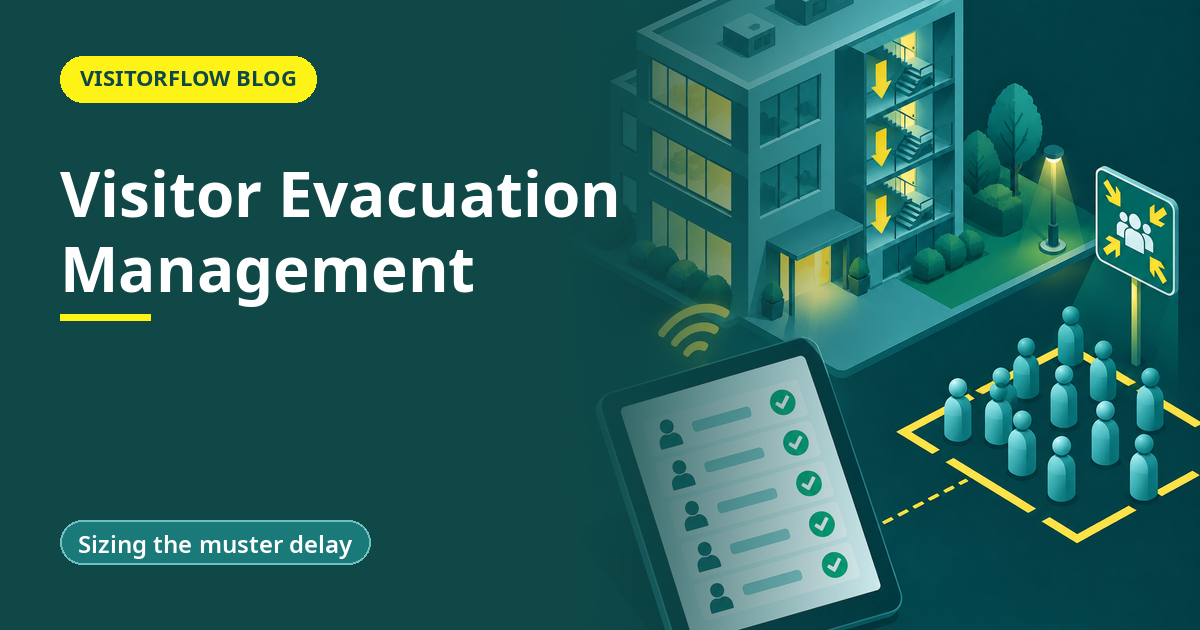
The fire alarm goes off at 11:35 on a Tuesday in a 400-person engineering plant. Employees file out to the muster point and line up by department while fire wardens count heads against the attendance app. At the gate, the security supervisor grabs the visitor register, a spiral book with that morning's entries, and starts reading names aloud. Two entries are illegible, one visitor checked in at 9:50 but nobody recorded whether he left, and a contractor's helper was never written in at all. Twelve minutes after the alarm, nobody can say for certain whether the building is empty.
This guide explains how visitor evacuation management works when the visitor list lives in software instead of a book: what an instant roll call looks like, what the record behind it must contain, and how to run a drill that proves it works. If you already run a visitor management system, this is the emergency half of the setup; our explainer on visitor management for legal compliance covers the audit half.
On this page
Why visitors are the gap in most evacuation plans
Visitor evacuation management is the practice of accounting for every non-employee on the premises during an emergency, using a live list of who checked in, who checked out and who is still inside. Most factories and offices already have an employee roll call that works, because attendance data is digital and current. The visitor side usually is not, and that is where headcounts stall.
The gap has three causes, and each one maps to a specific weakness of a paper register:
- Check-outs are weakly enforced. Visitors leave through a side gate, skip the register on the way out, or the guard is busy. The book says they are inside when they are not.
- The register is a single physical object. If it sits at the gate and the gate is inside the evacuation zone, the list evacuates with the building.
- Names alone do not help a fire warden. What the warden needs is who is inside, who their host is, and a phone number to call, all readable in seconds.
Key idea: In an evacuation, the question is never "who visited today"; it is "who is inside right now", and only a live check-in and check-out record can answer it.
There is a fourth, quieter cause: hosts rarely know they are part of the plan. When the alarm sounds, the person best placed to find a missing visitor is the host who brought them in, but in most plants the host hears the alarm, walks out with everyone else, and only thinks about their guest at the muster point. A system that notifies hosts on arrival can just as easily notify them on evacuation, which turns every host into a first checker for their own visitor.
Paper register vs desktop software vs cloud roll call
The three ways of keeping a visitor list differ most sharply in the ten minutes after an alarm. The table compares them on the points a safety officer and a fire auditor both check.
| During an evacuation | Paper register | Desktop software | VisitorFlow (cloud) |
|---|---|---|---|
| List of visitors still inside | Reconstructed by hand from entries and exits | Accurate, but only on the gate PC | Live list on any phone, filtered to checked-in |
| Reachable at the muster point | Only if someone carried the book out | No, the PC stays at the gate | Yes, on the warden's own phone |
| Host and phone number per visitor | Sometimes, if the guard wrote it | Yes, in the record | Yes, with one-tap call from the list |
| Time to a confident headcount | 10 to 20 min, often with unknowns | As long as it takes to reach the gate PC | Under a minute |
See the live visitor list on your own phone
VisitorFlow keeps a real-time list of everyone checked in, reachable from any browser, with no hardware at the gate.
Explore Visitor Management SoftwareBuilding an evacuation-ready record in three steps
A roll call is only as good as the record behind it. Three steps turn a check-in log into something a fire warden can trust at the muster point.
Step 01
Make check-out as enforced as check-in
The visitor list is only live if exits are recorded. With QR badges, the guard scans the badge on the way out, which takes two seconds. Every evening, review visits still marked open after closing time and close the genuine leftovers by hand.
Step 02
Capture host and phone number for every visitor
A warden with 14 names needs 14 hosts and 14 numbers. Make the host field mandatory at registration, and capture the visitor's mobile so the warden can call a missing visitor directly instead of guessing whether they left early.
Step 03
Drill the visitor roll call, not just the employee one
At the next fire drill, hand the live list to a warden at the muster point and time how long the visitor headcount takes. The National Building Code of India 2016 recommends regular mock drills for occupied buildings; use one of them to prove the visitor half of the count, not only the employee half.
Sizing the muster delay
The cost of a paper visitor list is easiest to see in minutes after the alarm. Substitute your own visitor volume below.
⚠️ Compliance note: Fire NOC inspections in most states ask how occupants are accounted for during emergencies, and the Factories Act 1948 requires occupiers to maintain safety of all persons on the premises, not only employees. A visitor record that cannot answer "who is inside" is a finding waiting to be written.
Under 1 min
To a live list of visitors still inside (worked example above)
2 sec
QR badge scan on exit, keeping the list honest
0
Hardware needed at the muster point; the list opens on any phone
Mistakes that leave the visitor list unusable
Common mistakes
- Treating contractors as exempt. A contractor inside the plant is a person to account for, badge type notwithstanding.
- Letting drivers wait "at the gate" without an entry. If the cab of the truck is inside the wall, the driver is inside your count.
- Running drills only with employees. The first time the visitor list is tested should not be a real fire.
- Keeping the only copy at the gate. Whatever the format, a list that cannot leave the building cannot run a muster.
What good looks like
- Every person inside the wall is in one system: visitors, contractors, drivers and interview candidates.
- Check-out is a two-second scan, so the inside list stays honest all day.
- Two wardens carry the live list link on their phones, tested at each drill.
- Open visits are reviewed every evening, so the morning list starts clean.
Reader Q&A
Does a visitor management system replace the fire warden's headcount?
No, it replaces the warden's paperwork. The warden still counts people at the muster point; the system supplies the list to count against, with hosts and phone numbers attached, so a mismatch is resolved in one call instead of a search.
What if the visitor has no smartphone for a QR badge?
The guard checks them in on the gate device and prints or writes a pass with a checkout code. What matters is that the entry and exit both land in the same record, not which device the visitor carries.
How do we handle visitors who leave without checking out?
Two controls: a two-second exit scan at the gate, and an evening review of visits still open after closing time. After a few weeks the open-visit count drops toward zero, which is exactly what the drill needs.
Should truck drivers be on the visitor list?
If the vehicle crosses the gate line, the driver is inside your premises and belongs in the count. Many plants register drivers against the vehicle entry so the material record and the people record stay consistent.
Does this work across multiple gates and buildings?
Yes, and that is where paper fails hardest. A cloud list combines every gate into one inside-now view, so a visitor who entered at Gate 1 and is still on site appears in the same list a warden reads at the far muster point.
What does this have to do with emergency notification?
They are the two halves of the same event: notification tells people to move, the roll call confirms they moved. Our companion post on emergency notification in visitor management covers the alerting side.
Bottom line
This week, pull yesterday's visitor register and count how many entries show a clear check-out time. If the share is under 90 percent, your evacuation list is already wrong before any alarm sounds.
This quarter, put the visitor list on the same footing as attendance: enforced check-out, mandatory host, and one drill where a warden runs the visitor count from a phone at the muster point. The metric to watch is the time from alarm to a confident visitor headcount; when it stays under two minutes in two consecutive drills, the plan is real.
Run your next drill against a live list
VisitorFlow runs visitor, material gate pass, courier, maintenance and incident workflows on one cloud platform, with no hardware at the gate.
Explore Visitor Management Software See Incident Management Software Book a Free Demo
Aadeshwar Modi is a marketing technical content writer who loves writing on technology and AI topics.
- From Register Book to Software: Digitizing the Gate Pass
- Inter-Branch Transfer Gate Pass: Keep Stock True Across Units
- Material Inward Gate Pass: Link the Gate with the GRN
- E-Way Bill vs Gate Pass: What Each Document Does
- Gate Pass System for Engineering and Fabrication Workshops
- Gate Pass Software for Pharma and Chemical Plants
- Office Facility Maintenance Checklist: Daily, Weekly, Monthly
- Breakdown Maintenance Log: Record, Analyze, Reduce
- Maintenance KPIs and Dashboards: What to Review Weekly
- AMC Management Software: Contracts, Renewals and Vendor SLAs