Visitor Management for Banks and Financial Offices
Published on 10/21/2026 • Updated on 10/23/2026
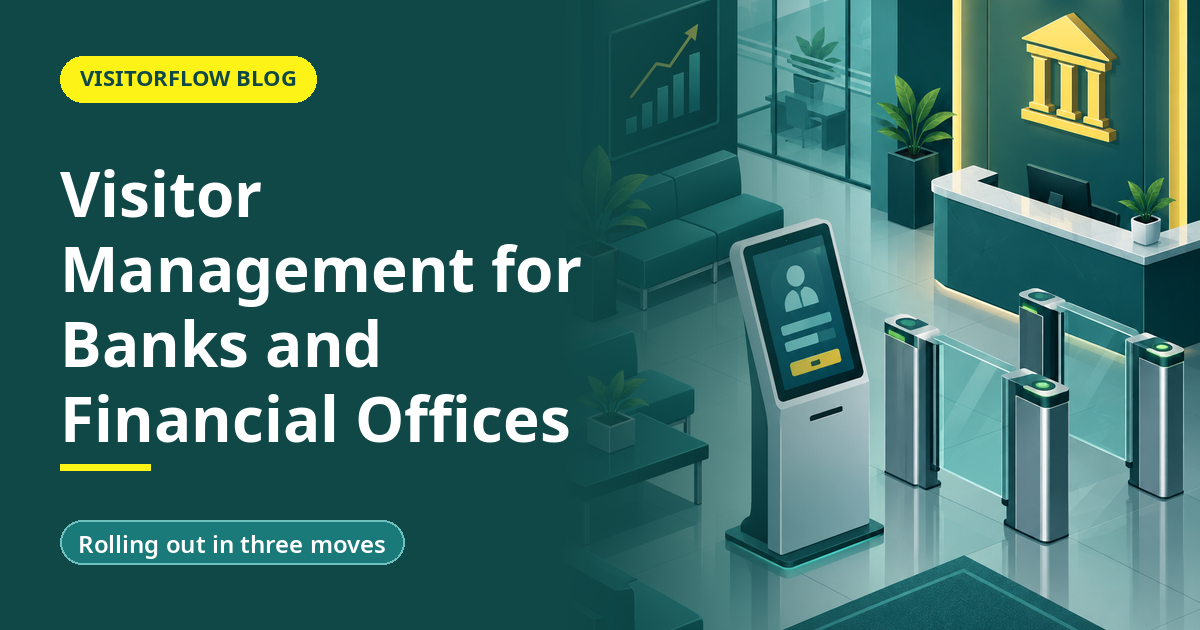
A private bank's zonal office occupies two floors of a commercial tower. The branch customers walk in downstairs and never need a visitor record. Upstairs is a different population: RBI inspectors on a scheduled review, core-banking vendors with data-centre access, cash-logistics crew swapping cassettes, auditors from the head office, a facilities team fixing the UPS, and a constant trickle of candidates for back-office roles. The security desk keeps a register that says, for most of these people, a name, a time, and the word "official".
This guide covers visitor management for banks and financial offices: the regulator-shaped reasons the visitor record matters, the zones that need different rules, and how to run vendor and inspector traffic without a paper trail of panic before every audit. For the general check-in mechanics, our complete guide to visitor management systems covers the basics.
On this page
Why bank visitor records are a regulatory artefact
In most industries, the visitor register is an operational tool that occasionally helps in a dispute. In banking, it is part of the control environment. The RBI's cybersecurity and IT governance expectations for regulated entities treat physical access to systems and data areas as a control to be logged and reviewed, and internal audit teams test those logs. A visitor record that says "official" for a vendor who spent three hours in the server room is not a record; it is a finding.
Three properties make the banking version of visitor management stricter than the generic one:
- Zone discipline: the lobby, the operations floor, the cash area and the data room have different rules, and the pass must say which zones the visitor may enter.
- Approval provenance: who authorised the visit matters as much as who visited, because audit trails are tested end to end.
- Retention and review: visitor logs are retained, periodically reviewed, and produced during inspections, so they must be complete, legible and searchable years later.
Key idea: In a bank, the visitor log is not about the visitor; it is evidence that the institution controls its own premises.
Zones and visitor types: who may go where
The visitor types that need distinct treatment in a financial office:
- Regulators and inspectors: pre-announced, escorted, and entitled to a complete visit history on request, including their own past visits.
- IT and core-banking vendors: data-room or ops-floor access, often after hours, always escorted, with the work order referenced on the pass.
- Cash logistics and ATM crews: identity-verified against the agency's roster, short stays, strict zones.
- Internal visitors: staff from other branches or the head office, who are employees but not of this location and still need a record.
- Candidates and business guests: interview panels, corporate clients visiting the zonal office, consultants in meeting rooms.
The common thread is that each type maps to zones and an approver, not just a name in a book. When the pass itself encodes "vendor, data room, escorted, valid till 18:00", the guard's judgment call disappears from the security chain.
Desk register vs standalone badge printer vs an integrated system
Banks commonly move from a register to a standalone badge-printing kiosk and stop there. The comparison shows what the middle option misses.
| What the control needs | Desk register | Standalone badge kiosk | VisitorFlow (integrated system) |
|---|---|---|---|
| Approval recorded before entry | Verbal, unrecorded | Host typed at the kiosk, unverified | Host approves from their phone before the pass issues |
| Zone and escort rules on the pass | No | A badge, but no enforcement | Printed and enforced at zone checks by scan |
| After-hours vendor work tied to a work order | Name and "official" | Badge only | Visit references the approved work order |
| Produce a vendor's full history in an inspection | Days of register hunting | On the kiosk PC, if exported | One search, exportable, years later |
A visitor log your auditors will like
VisitorFlow records the approval, the zones, the escort and the work reference on every visit, searchable years later.
Explore Visitor Management SoftwareRolling out in three moves
Move 01
Map zones and visitor types before any software
List the zones (lobby, ops floor, cash area, data room) and which visitor type may enter each, with whose approval. This one-page matrix is the policy; the system simply enforces it at the pass.
Move 02
Move vendor visits onto work-order-linked passes
Every IT and facilities visit references an approved work order, names the escort, and expires at the scheduled end. The data room stops being a place vendors happen to be and becomes a place they are provably authorised to be.
Move 03
Review the log before the auditors do
A monthly review of after-hours entries, long-stay visits and unescorted zone exceptions finds control gaps while they are still cheap. The inspection then confirms what you already know, which is the entire point of a control log.
Reader Q&A
Do branch customers need visitor passes?
No. The banking hall is a public counter during business hours. Visitor management applies to non-public areas: back offices, ops floors, data rooms and administrative offices above or behind the branch.
How are RBI or statutory inspectors handled?
As pre-registered, escorted visits hosted by compliance. The system records their entry, their escorts and their zones, and the same search later produces the institution's side of the interaction if questions follow.
Can staff from other branches sign in faster?
Yes. Internal visitors are verified against the employee directory and get a location pass in seconds. They are employees, but of the institution, not of that premises, so the location still keeps a record.
How long should bank visitor logs be retained?
Follow your internal records policy and any regulatory guidance your compliance team applies; many institutions retain security logs for several years. Define the period, automate the purge for personal data beyond it, and document both.
Can cash-agency crews be pre-verified?
Yes. The agency's roster is loaded in advance, and the crew member's ID and roster entry are matched at the desk before the cassette room opens. A name that is not on today's roster does not get in on a confident smile.
Does this replace the access-control system?
No, it complements it. Access control governs doors for cardholders; visitor management governs the people without cards: who approved them, where they may go, and the record of the visit. The strongest setups scan the visitor pass at zone doors too.
Bottom line
This week, pull the register entries for your last three after-hours vendor visits and check whether each one names an approver, a zone and a work reference. If any read "official", your control has a hole an auditor will find.
This quarter, write the zone matrix, link vendor visits to work orders, and start the monthly log review. The metric to watch is the share of visits with a recorded pre-entry approval; in a regulated office that number should be 100 percent, not a target.
Control the premises, prove it later
VisitorFlow runs visitor, material gate pass, courier, maintenance and incident workflows on one cloud platform, with no hardware at the gate.
Explore Visitor Management Software See Maintenance Software Book a Free Demo
Ed Jhonson is a Sourcing & Marketing Expert who writes content related to Technology and Engineering topics.
- From Register Book to Software: Digitizing the Gate Pass
- Inter-Branch Transfer Gate Pass: Keep Stock True Across Units
- Material Inward Gate Pass: Link the Gate with the GRN
- E-Way Bill vs Gate Pass: What Each Document Does
- Gate Pass System for Engineering and Fabrication Workshops
- Gate Pass Software for Pharma and Chemical Plants
- Office Facility Maintenance Checklist: Daily, Weekly, Monthly
- Breakdown Maintenance Log: Record, Analyze, Reduce
- Maintenance KPIs and Dashboards: What to Review Weekly
- AMC Management Software: Contracts, Renewals and Vendor SLAs