Visitor Management for Warehouses and Logistics Parks
Published on 10/21/2026 • Updated on 10/22/2026
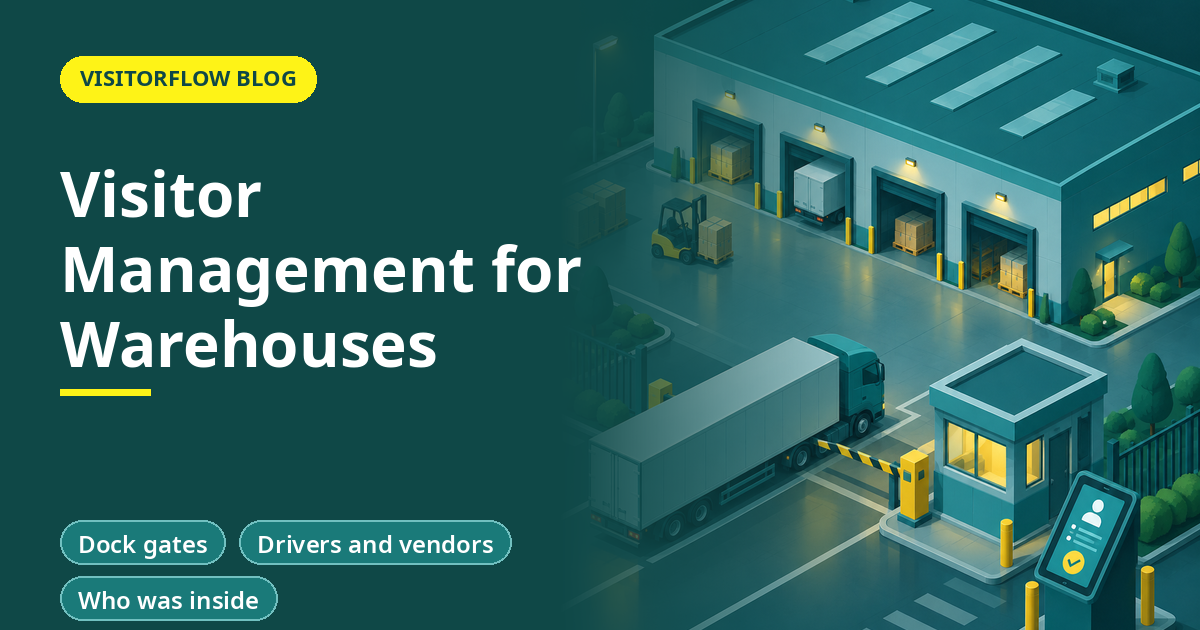
A logistics park outside Bhiwandi runs four warehouses and 200 dock doors. On any given day the gate sees truck drivers, picker-vendor supervisors, forklift AMC technicians, insurance surveyors, e-commerce quality auditors, and the occasional job applicant who wandered in behind a truck. The gate register logs them all in the same book, in the same columns, with the same illegible scrawl. When a pallet of high-value electronics goes missing and the insurer asks who was inside warehouse 3 that afternoon, the register answers with three hours of handwriting archaeology and no certainty.
Warehouses and logistics parks have a visitor problem that looks like a traffic problem: high volume, many categories, tight dock schedules, and real safety and shrinkage stakes. This guide covers how visitor management works at a warehouse: the categories to separate, the flows each one needs, and what the records must prove. It builds on our security guard visitor entry checklist and our guide to managing visitors, contractors and temp workers in one system.
On this page
The five categories at a warehouse gate
Everything that enters a warehouse gate is one of five categories, and each needs a different flow. Truck drivers: tied to a dock appointment, a vehicle, and a loading or unloading job; their check-in is about schedule and dock assignment, not hospitality. Contractors and technicians: forklift AMC, racking inspectors, pest control; they need safety briefings and zone limits. Vendor and customer visitors: quality audits, capacity reviews; they need a host and often an NDA. Inspectors and surveyors: insurance, fire, statutory; they need escorts and a record that survives their own report. And everyone else: applicants, salespeople, lost cab drivers; the flow's job is to keep them at reception.
One register treating all five alike is the root failure. The driver's two-minute check-in queues behind the surveyor's fifteen-minute one, the safety briefing gets skipped when the line is long, and the register mixes the truck that delivered with the person who might have walked out with a box.
Key idea: A warehouse gate is really five small gates wearing one roof; the system that separates the flows is the one that keeps both the dock schedule and the evidence.
One register vs separate books vs a VMS
Organised parks graduate to separate registers (driver log, contractor log, visitor book), which fixes the queue and breaks the reporting. The comparison shows where each lands on the questions a warehouse actually gets asked.
| What the park needs | One register | Separate registers | VisitorFlow (VMS) |
|---|---|---|---|
| Driver check-in under two minutes | Queued behind everyone | Separate line, still handwritten | Appointment QR, dock assigned at scan |
| Safety briefing before floor entry | Skipped when the line is long | Verbal, unrecorded | Acknowledged on screen, stored per visit |
| "Who was in warehouse 3 at 3 PM?" | Hours of archaeology | Three books, no zones | Zone and time filter, one report |
| Evacuation roll call | Registers carried out and counted by hand | Three lists to reconcile mid-alarm | Live roll call on any phone |
Five flows, one gate, zero archaeology
VisitorFlow separates drivers, contractors and visitors into fast flows with safety briefings, zones and searchable records on every entry.
Explore Visitor ManagementDesigning the flows
Flow 01
Drivers: appointment-first check-in
Dock appointments carry a QR. The driver scans at the gate, the system matches vehicle and job, assigns the dock, and stamps arrival. Detention disputes end, because arrival and departure times are no longer anyone's word against anyone's.
Flow 02
Contractors: briefing and zones before the badge
Safety briefing acknowledged on the check-in screen, zones set to the work area, PPE photo if your policy wants one. The racking inspector never gets the flow written for a job applicant.
Flow 03
Visitors and auditors: host accountability
Pre-registered by their host with an NDA at check-in where policy says so. The host gets an arrival ping and owns the visit; the audit trail shows who brought whom into which warehouse.
Flow 04
Everyone else: a polite full stop
Walk-ins without a sponsor get a reception-side flow that ends at reception: details captured, host called, decision made. The gate stops being the place where anyone can become a "visitor" by writing neatly.
Safety and shrinkage records
Two record types justify the whole system. Safety: the fire officer's drill asks how many non-employees are inside, by warehouse, right now; the live roll call answers from any phone, and the drill report shows the answer existed. Our evacuation management guide covers the roll-call mechanics in detail. Shrinkage: when stock walks, the investigation's first question is who was present and unescorted in that zone in that window; zone-tagged visits turn a three-day review into a filtered report.
The insurer angle is real money. Claims for stock loss routinely hinge on demonstrating who had access; parks with searchable visitor and contractor records settle faster and defend premiums better than parks with handwriting.
Reader Q&A
Do drivers really need to be in the visitor system?
They need a fast lane in it, not the full visitor flow. Their check-in is appointment and dock focused, but their presence belongs in the same roll call and the same "who was inside" report as everyone else.
Our park has four warehouses with separate gates. One system?
Yes, that is the point. One system across gates gives you the park-wide roll call and the cross-warehouse presence report; four gate books give you four silos and a reconciliation problem on the day it matters.
How do we keep drivers' personal data safe?
Capture the minimum the flow needs, keep records access-controlled, and run retention with automatic purge. A driver ID in a system with a purge schedule is far safer than a photocopy in a gate cabin drawer.
What about seasonal volume spikes?
Festival-season peaks are exactly when appointment QRs earn their keep: the gate's throughput scales with scanning, not handwriting, and the dock schedule absorbs the spike without a second clerk.
Can security guards run this without training days?
The gate screen asks the guard to scan a QR or search a name; everything else is automatic. Most parks train a guard team in one shift, and the checklist behaviour (ID shown, photo taken, briefing acknowledged) is enforced by the flow rather than the guard's memory.
Does it integrate with our WMS dock scheduling?
Appointment data can flow in from the WMS or be raised in the visitor system directly; many parks start standalone and connect later. The gate value (fast check-in, zones, roll call, evidence) does not wait for the integration project.
Bottom line
This week, ask your gate for two answers: how many non-employees are inside right now, and who was in a named warehouse during a named hour last week. Time both answers. The first is your evacuation readiness; the second is your shrinkage defence.
This quarter, split the gate into its five flows, put drivers on appointment QRs, and make safety briefings a screen instead of a speech. The metric to watch is check-in time per category alongside drill-day roll-call accuracy; both should improve together, and the insurance file gets stronger as a side effect.
A gate that knows who is inside, always
VisitorFlow runs visitor, driver, contractor and evacuation workflows on one cloud platform across every gate in your park.
Explore Visitor Management See Material Gate Pass Software Book a Free Demo
Ed Jhonson is a Sourcing & Marketing Expert who writes content related to Technology and Engineering topics.
- From Register Book to Software: Digitizing the Gate Pass
- Inter-Branch Transfer Gate Pass: Keep Stock True Across Units
- Material Inward Gate Pass: Link the Gate with the GRN
- E-Way Bill vs Gate Pass: What Each Document Does
- Gate Pass System for Engineering and Fabrication Workshops
- Gate Pass Software for Pharma and Chemical Plants
- Office Facility Maintenance Checklist: Daily, Weekly, Monthly
- Breakdown Maintenance Log: Record, Analyze, Reduce
- Maintenance KPIs and Dashboards: What to Review Weekly
- AMC Management Software: Contracts, Renewals and Vendor SLAs